Soldiers in the military worldwide are committed to protecting their nation, and there are dedicated manufacturers working on high quality composite components to protect them. The rising use of composite materials and the advancements in material blends and their fabrication have allowed composite component manufacturers to meet the demanding requirements for military vehicle components.
Using traditional materials such as high quality steel for components and vehicle protection have downfalls in the constantly evolving threats and performance requirements needed to combat those threats. The excessive weight of a material like steel can severely affect the performance and survivability of vehicles in the field because of the increased vehicle weight and thus necessary modification to the suspension system to support the increased inertial energy. Vehicle maneuverability can be significantly impaired as well, and with the advent of smarter weapons and threats to the soldiers, the ability to get in and out of a hostile situation is paramount.
Through partnerships and cooperative working arrangements, composite manufacturers can take requirements and design parameters and walk a customer through the design, testing and analysis, and eventual engineered manufactured end product with the exact features and qualities required for the specific application.
Extreme circumstance, extreme benefits
Weight savings is one of the top benefits associated with composite usage in mobile equipment, allowing for increased payload and fuel efficiency, higher speed capability and performance. “Reduced weight of a wheel, for example, improves its acceleration and deceleration, but it also dramatically improves fuel economy and improves the suspension. Areas like that are prime for additional lightweighting,” explains Fiberforge (Glenwood Springs, CO) president and CEO Jon Fox-Rubin.
Composites also have an infinite fatigue life. Steel can go an estimated one billion cycles before fatigue and aluminum an estimated one million cycles. Using aluminum as a replacement for steel offers weight savings, but must have its fatigue life taking into consideration. Something that rotates, such as a driveshaft, goes through a lot of cycles in a short period of time.
Challenging environments also benefit from composites’ corrosion abilities—they simply do not rust.
“Two of the critical design parameters of composites are the stiffness-to-weight ratio and the strength-to-weight ratio. Composites have benefits over metals in both of those categories. With a composite you can orient the fibers along the path that is either stiffness dominant or strength dominant and have an increase in stiffness- or strength-to-weight over a metal,” says Fox-Rubin.
“One thing that most people don’t realize is that most structures that are designed like a frame of a car or a door panel, their design is dominated by the stiffness of the panel, not the strength of the panel. Stiffness-to-weight is the dominant design variable that an engineer is optimizing.”
Designed properties
An advantageous feature of composites is their ability to have their strengths strategically placed. Composite properties are optimal in the direction of the fibers. Since most structures do not have loads in one single direction, stacking multiple layers of composite plies allow fibers to be oriented in multiple directions to bear multi-directional loads and forces.
The most efficient composites accomplish low weight and cost by having most of their fibers oriented in the primary load direction, and just enough fibers oriented in the other directions to carry secondary loads and hold the structure together.
For military vehicle composite components, weight and cost are the targeted properties. “Strength is a given for military applications,” says Brad McPhee, president and CEO, Creative Composites, Rapid River, MI. “In terms of combat vehicles, structurally the vehicles are overdesigned for protection purposes, but that is what makes them heavy. The composites are to make the design and vehicle overall lighter. Many customers have a dollar-per-pound-saved target they are willing to pay, and different industries have different targets.”
“Because of the in-theater costs of fuel and other logistic issues, as well as armor and similar materials, the military is willing to pay substantial premiums for weight reductions that most commercial applications would not consider,” says Alan Johnson, director of business development, Norplex-Micarta, Postville, IA.
The range of materials used in composites is innumerable. Creative Composites’ materials vary from Kevlar to fiberglass to carbon fiber, and are oriented with some unidirectional, some stitched, and still others woven.
Fiberforge approximates 70% of its products contain carbon fiber in them. “A low cost composite featuring glass fiber and PET resin (the same material used in plastic bottles) features the interesting property of complete radio transmit capability, meaning it doesn’t interfere with radio waves, a nice property of glass fiber. That material runs about $4 per pound of material,” says Fox-Rubin.
“Glass fiber is maybe 20-30% lighter than steel, but to get 50-60% lighter than steel you have to go to carbon fiber composites.
“A middle performance material would be carbon fiber nylon, currently used on a military product that we can’t disclose, that runs around $20 per pound of material.
“On the high end of performance we use carbon fiber PEEK (Poly-ether-ether-ketone). That is on the order of $100 per pound of material but has high toughness and material properties. It’s the best competitor for titanium. The carbon fiber nylon is one of the best competitors for aluminum.
“The glass fiber PET is a good competitor for aluminum at comparable weight to aluminum, so it really depends on the use whether it will be better than aluminum or not, whereas the carbon fiber nylon is lighter than aluminum but is more expensive,” he says.
Norplex-Micarta offers its ShotBlocker line of high performance thermoset composite sheets, prepregs (reinforced materials pre-impregnated with resin and ready to use to product composite parts) and molded shapes to meet the growing requirements for ballistic protection.
Its NP522 and NP523 fiber-glass-based ballistic-resistant composites are formulated to meet the stringent military requirements (NP523 complies with MIL-L-64154 and MIL-DTL-64154B, Class A, Code 1. NP522 complies with MIL-DTL-64154B Class B, Code 2). The Norplex-Micarta ShotBlocker materials are offered as fully-cured, rigid sheets, or as prepregs. Sheet thicknesses range from 0.062 to 8.0 inches, and sheet sizes up to 48 by 120 inches.
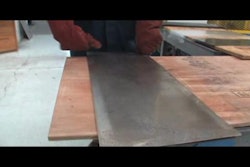
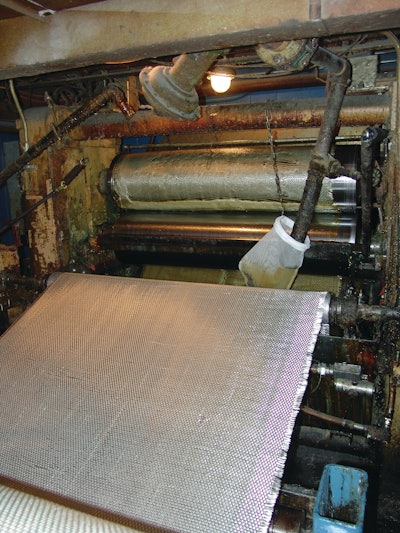
Ballistics sheet material manufacturing starts with woven fiberglass fed into a bath of phenolic resin which is then carried through a series of rollers to squeeze off excess resin. The wetted-out fabric heads through a 150 ft. oven to burn off volatiles, leaving it in a semi-cured state, and then trimmed to the required dimensions. The sheets are stacked, weighed and pressed into a solid sheet to be used in ballistic construction applications.
Other companies, such as Kanpur, India’s MKU Pvt. Ltd. and ArmorWorks LLC of Chandler, AZ, provide armor for military vehicles made from light weight ceramic-based composite materials which have a high brittle feature while offering extreme hardness and superior resistance to armor piercing rounds and high kinetic projectiles.
Back in 2007, ArmorWorks announced the development of a high-performance, low-cost composite armor suite for the U.S. Marine Corps (USMC) new Expeditionary Fighting Vehicle (EFV).
The ballistic effectiveness of this hybrid composite armor for the EFV provides unique combinations of dissimilar composite materials that offer lighter weight protection. The technology uses backings in ceramic and fragment armor systems, which reduces cost and improves multi-hit protection and structural integrity of ceramic armors against armor piercing bullets, artillery fragments and improvised explosive devices (IEDs).
MKU’s ceramic composite panels are made of ceramic tiles matrixed under various layers of material. Its advanced ceramic composite (ACC) panels use high performance, lightweight ceramics which perform well across a wide temperature range and offer multi-hit capabilities. Comparatively, MKU’s standard ceramic composite panels offer the same level of protection and performance, but at a lower cost, compromising the weight reduction benefits of the ACC panels.
Present and future challenges and solutions
“Composites are one of those areas where you need to understand how each part of the process affects the other,” says McPhee. “When you work with structural composites, just because the design is good and it looks good, doesn’t make the part good. For example, the reinforcement may be wrong. Conversely, if a part is designed well and structurally, when analyzed, handles all of the loads and stresses, but it compromises the shape and design of the part, that is a problem as well.”
It is important that composite companies are capable of working with a customer at all stages of the product development cycle, from design to production, to provide a fully-designed product.
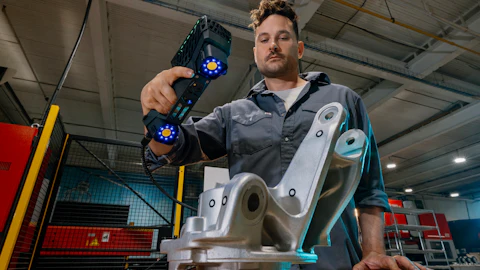
An area that is really lacking is experience with all of the different potential combinations of materials and the ability to analyze them. There is a void of comprehensive CAD/CAM analysis with high levels of reliability. For example, explains Fox-Rubin, the analysis tools for crash energy absorption for composites are not up to par with those for metals “because composites don’t have the same material properties in every direction, so they are much more challenging to model. It’s just going to take more time for the software community to catch up to the material properties and be able to fully develop tools that designers can use and be comfortable with.”
Fox-Rubin feels that in the short term, vehicles will be a little overdesigned to compensate for the analysis capabilities currently available, but as experience is gained to analyze the structure and forces acting on it, the testing and design will be optimized even more.
High temperatures are another hurdle in the composites industry. While a composite can be designed to handle a high temperature, most still can’t handle a temperature as high as engine combustion, for example. There are examples of composites used in engine blocks for automotive racing, but thus far that composite component has a lifetime of one race, so there is room for improvement in finding composites for extreme temperature instances. Currently, there isn’t the reliability necessary to use composites in those high temperature locations. And, as Fox-Rubin notes, “when you look at military and off-road markets, you really want reliability.”
There is a lot of development on the resin side for advanced composites. “I think we’re starting to see thermoplastics growing in the composite space, and I believe they will be used more in wheeled vehicles than thermosets in the long run because of the toughness of the resins and the ability to go down on the cost curve,” says Fox-Rubin. “There are already companies with a number of different thermoplastic resins that are designed, developed and used in billions of pounds per year for injection molding, and those same resins can be combined with continuous fibers for structural parts. It’s not necessarily about inventing new materials, but rather inventing processes for turning those materials into parts.”