While the future will likely be powered by a variety of fuel sources, one can’t ignore the investment in wind energy. The Global Wind Energy Council (GWEC) reports the world’s wind power capacity grew by 31% in 2009, bringing total installations up to 157.9 gigawatts (GW). There are now wind turbines operating on every continent; the main markets being Asia, North America and Europe.
According to GWEC, the global market for turbine installations in 2009 was worth around $63 billion, and a half-million people are employed by the wind industry worldwide.
Any growth during one of the worst recessions in history is worth noting, and a number of mobile off-highway equipment OEMs and suppliers have sought opportunities to diversify their portfolio in this green industry.
Communities have, too. Last summer, Bismarck, ND, had the lowest jobless rate in the nation, at 3.6% . Thanks to a diversified economy, the capital city of 60,000 was surviving the global crisis with nary a scratch. But troubling news came: Doosan Infracore Co. would close its Bobcat plant there, where 475 worked.
The employment situation in Bismarck was such that the city could absorb the job losses: those who needed to work could still do so; other businesses were expanding. “But we wanted to replace those manufacturing jobs as quickly as we could,” says Russell Staiger, president and CEO, Bismarck-Mandan Development Assn. When Bobcat left Bismarck, it took the largest piece of the area’s manufacturing sector.
That’s where wind energy comes in. North Dakota ranks very high for available wind energy in the United States, with the potential for more than 3 million GW.
Considering the transportation challenges posed by the size of the wind turbine’s components, Staiger believes North Dakota —Bismarck in particular— is a natural location for such manufacturing to take place. Schuff Intl. Inc., Phoenix, AZ, thinks so, too. It is pursuing a new wind tower manufacturing plant there.
Schuff is the largest supplier of specialty fabricated steel in the country. Major projects include bridges and stadiums. In Bismarck, Schuff anticipates building a 200,000-sq.-ft. facility on 70 acres, with potential employment of up to 300. While there are a number of significant issues yet to be resolved, Schuff hopes to begin building the facility within the year. The company’s proposed plant in North Dakota was selected as one of 133 projects eligible to receive a federal tax credit as part of the American Recovery and Reinvestment Act (ARRA).
The U.S. installed nearly 10 GW in 2009, increasing the country’s capacity by 39%, according to the GWEC. “But U.S. wind turbine manufacturing is down compared to last year’s levels, and needs long-term policy certainty and market pull in order to grow,” says Denise Bode, CEO, American Wind Energy Assn.
The financial crisis did impact the development of new wind turbines, says Giuliano Spaggiari, vice president sales and product development for Italy-based Comer Industries. “But we believe the setback is temporary. The fundamentals of this industry are strong, not only for environmental protection, but to offset the cost of energy.”
Comer diversified into wind energy in the 1980s, and has learned along with the industry. Today, it makes up more than 10% of Comer’s overall business. It draws on its experience with products that control yaw (the orientation of the nacelle into the wind), and pitch (angling the blades to control the surface area exposed to wind).
“There are only a few leading companies making wind turbines. It is a consolidated market with a very high entry barrier,” says Spaggiari, “not only capital but technological.”
Perched 100 ft. above difficult terrain, component failure in the nacelle is expensive and potentially catastrophic. Spaggiari sees the wind turbine industry as a growing market, but one that is high-risk. “There is a ratio between risk and product value. If a gear fails in an excavator, it will generate a certain amount of damage. Providing gears to wind energy is closer to the aerospace industry, requiring a high skill level and risk management.”
The crane industry has benefited from the popularity of wind energy —you can’t make a wind farm without them. The Grove GTK1100 was designed with wind power in mind. Manitowoc Co. engineers combined a superstructure from the GMK7450 all-terrain crane with an 80 m five-section telescoping tower and a hydraulic chassis. The result is a crane with a short working radius, tall height and strong capacity.
Manitowoc’s crawler cranes are also in on the action. “Since the Manitowoc 16000 launched four years ago, it has become one of the leading cranes for wind turbine erection in the U.S.,” says Mike Wood, global product director for Manitowoc’s crawler cranes. “Approximately 85% of the 16000 cranes we build are used in wind power work. The cranes are quick and easy to erect and disassemble, and are equally easy to transport.”
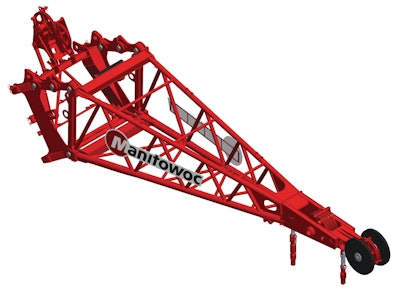
A new attachment for Manitowoc’s Model 16000 crane boosts its capacity to place the latest generation of wind turbines. In recent years, turbines with a 1.5 MW generating capability have been common. There has been a shift to 2.5 MW and larger turbines as wind farm operators maximize the productivity of their land. Positioning these large turbines requires cranes with greater capacity and reach, which is what the attachment offers.