A truck stop in a small town just north of OEM Off-Highway‘s office serves a mighty fine breakfast, and the area farmers know it. On any given morning you are as likely to hear the farmers talking about sensors and satellites as you are torque and tires. Software, GPS, virtual terminals and other features have helped make significant improvements in the business of growing food. It’s made straight lines and repeatability possible in every field, while providing real savings in time, fuel, and material. While suppliers and OEMs work to drive the functionality of precision ag systems to the next level, the technology is becoming available to farms of nearly all scales — it’s no longer something you’ll only see used by large growers and custom operators. These systems are also being made available to universities. Thanks to this early exposure, some of those students will likely play a role in precision agricultural systems yet to be developed.
Giving a head start
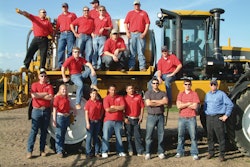
Thanks to a long-term partnership between Case IH Agriculture, Ritchie Implement Inc., and the University of Wisconsin-Platteville (UWP) Pioneer Farm, students in UWP’s School of Agriculture will have access to the newest agricultural equipment and precision farming technologies available. Case IH tractors, a combine and other equipment will be delivered in early 2010 and each year thereafter.
“Access to new Case IH agriculture equipment will be a tremendous asset to Pioneer Farm — the precision farming solutions will greatly increase the productivity of our operations,” says Phil Wyse, director of Pioneer Farm. “But more so than that, this partnership advances the mission of Pioneer Farm — to enhance the agricultural education experience for students on campus and for agriculturists throughout the surrounding communities. That’s what we’re really excited about.”
Pioneer Farm, the university’s 430-acre farm, boasts some of the best soil in the region. The gently rolling fields rotate between corn, oats and alfalfa. Those crops help support the farm’s dairy, beef and swine enterprises.
“Students and university researchers will get to see, run, test and learn all about the newest innovations in production agriculture first-hand,” says Ron Ritchie, president of Ritchie Implement Inc., a Case IH dealer with three locations in southwest Wisconsin. “Our goal is not only to broaden ag students’ educational experience and better prepare them for their farming careers, but also to enhance educational opportunities for active producers locally, regionally and across the state.”
As part of the agreement, Case IH product specialists will be available to support classroom instruction. The university will assist Case IH in engineering research and by testing new products. Case IH and Ritchie’s will also have the opportunity to bring customers and employees to Pioneer Farm to see their equipment in action.
An application for precision ag
Application equipment has been one of the big winners from the adoption and expansion of precision agriculture technology. Ten years ago, most sprayer operators weren’t interested in trying lightbars to guide them through the field; they knew foam markers worked. Today, precision agriculture has taken over, and it’s gone beyond yield monitors in combines and automated steering in tracked tractors. With their proven ability to save time, money and the environment, precision ag systems are becoming more common on lower-cost machines.
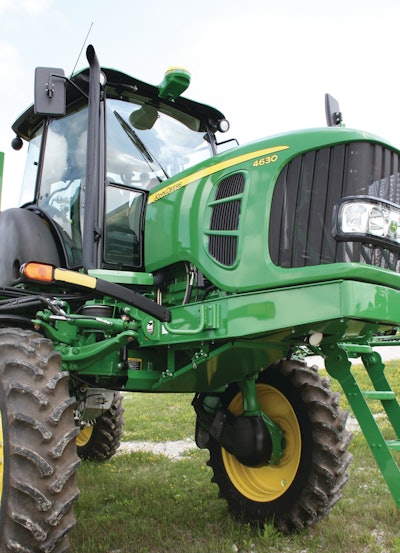
This summer, John Deere placed an economy-sized model in its 30 Series self-propelled sprayer line. The 4630, which replaces the discontinued 6700, is intended for cotton, corn, soybean, and small-grain farmers who want a low-cost, productive machine that’s simple to operate.
“The 4630 sprayer comes equipped with features similar to John Deere’s larger sprayer models, and it offers many performance enhancements and operator comforts previously available only on the larger machines,” says Nick Weinrich, product manager.
Features include a GreenStar AutoTrac-ready CommandView cab. John Deere’s AutoTrac-ready system provides the necessary wiring harnesses to run GreenStar guidance and field documentation applications. Customers can add a StarFire global positioning receiver and use it in conjunction with the standard GreenStar 2 1800 display or optional GS2 2600 display to run guidance applications such as AutoTrac and Swath Control Pro. The GS2 2600 display enables operators to create as-applied maps and utilize documentation features found in larger John Deere 4730, 4830, and 4930 Sprayers.
When customers order a 4630, they can choose between a narrow 72- to 88-in., or wide 90- to 120-in. axle configuration, flexibility that allows it to fit in most crop applications around the world. The C-channel frame and air-ride, four-link suspended axle provide a smooth ride that lets farmers spray at up to 17 mph. The 4630 sprayer features a 600-gallon tank.
And now, more options
Following a recent agreement, Deere’s dealers now offer select crop solution products from Raven Industries, supplementing products from John Deere Ag Management Solutions (AMS). The agreement with Raven includes seven application products in five product categories: anhydrous ammonia (NH3) delivery, direct injection, plus rate, section, and boom height control.
Accurate and efficient application continues to be crucial for producers to minimize input costs, especially as the price of fertilizer and chemicals rise. Raven AutoBoom, SmartBoom, and the SCS consoles can help producers in these areas. With the AutoBoom line-up of PowerGlide Plus and UltraGlide, John Deere dealers have a compatible solution for customers who require automatic boom-height control for their sprayers to reduce chemical drift and boom maintenance.
“With automatic rate and section controls,” says AMS’s Kim Fletcher, “farmer’s input costs are reduced, as chemicals are placed where they are needed, in exactly the right amount. Raven SmartBoom is a low-cost entry level liquid-only system for customers who want reduced overlap, input costs, and increased environmental stewardship.”
The Raven line will complement current John Deere products and create systems to help producers manage their input costs. “With the addition of these Raven products, producers can visit their local John Deere dealer, gain access to a wider selection of precision technologies to meet their needs, and receive the same renowned service and support they’ve come to expect,” says Mark Theuerkauf, factory-marketing manager for John Deere AMS.
“The Raven AccuFlow system is an integral piece in completing the John Deere NH3 [anhydrous ammonia] solution. Producers will be able to build a complete NH3 solution from the front of the tractor to the rear of the nutrient applicator, all at their John Deere dealer,” says Theuerkauf.
and for the red sprayers...
Case IH’s new 800 gallon 3230 sprayer is the smallest of the Patriot sprayers, but it gets the Case IH Surveyor cab with the same amenities found in larger Patriot sprayers, Magnum and Steiger tractors and Axial-Flow combines.
“Sprayer operators put in a lot of hours in the course of a day, week or season — they need to be as comfortable and efficient as possible during their time in the cab,” says Ken Lehmann, Case IH application equipment marketing manager.
The smaller Patriot is available with the Case IH AFS AccuGuide-ready option. When so equipped, operators are more efficient because automated steering reduces stress and lets operators concentrate on application rather than steering. And by reducing the number of skips and overlaps, AFS AccuGuide saves on fuel and chemical input costs.
“This new sprayer shares the same design DNA as the larger Patriot sprayers,” Lehmann explains. “That means a smoother ride for operators, more acres sprayed every season and better application accuracy in the field.” All Patriot sprayers offer control of product application with multiple features that contribute to spray performance, such as precision control of boom height, rapid changes in spray nozzle rate, GPS-guided boom-section control, and fully automated steering.
The AFS AccuGuide Ready option offers plug-and-play auto guidance readiness for use with the AFS Pro 600 display, the AFS 262 GPS receiver and the Navigation II controller. These components are also used on other Case IH equipment for guidance, machine control or monitoring and can be easily moved from one piece of machinery to another.
Users can also choose the AIM Command spray system, which multiplies the utility of a standard chemical boom, providing precise spray with complete control. The system offers constant pressure independent of speed, with near instantaneous ability to switch rates while using a single nozzle tip.
Focusing on electronics
Group works to implement international electronics standards.
The Agricultural Industry Electronics Foundation (AEF) concentrates on practical solutions that ensure the compatibility of tractors, implements and office computers as well as the advancement of precision farming. AEF’s main area of focus is the implementation of international agricultural electronics standards.
The AEF’s initial focus lies in ISOBUS implementation. Six AEF Project Teams are addressing implementation issues: conformance testing, functional safety, engineering and implementation, service and diagnostics, sequence control and communication and marketing. The Conformance Test Project, for example, is responsible to ensure that the ISOBUS data traffic between office computer, tractor and implement flows seamlessly, regardless manufacturer.
“As an independent, industry wide body we cooperate in promoting technical compatibility, efficiency of resources and functional safety of agricultural machinery,” says William Rudolph, AEF secretary. “This is a very important issue, as electronics have become the crucial driver of innovation in agricultural technology altogether.”
AEF was founded in October, 2008, by seven companies: AGCO, Claas, CNH, Grimme, John Deere, Kverneland Group and Pöttinger. Additional founding members are the industry associations Association of Equipment Manufacturers (AEM) and German Engineering Federation (VDMA).
General membership is open to any organization or individual with an interest in promoting the implementation of international, agricultural electronic standards. There is no fee to become a general member; the foundation is financed by its seven founding members.
AEF will have a booth at AEM’s Jan. 13-15, 2010 AgConnect Expo in Orlando, FL. For more information, visit www.aef-online.org.