In early February, Wisconsin Governor Jim Doyle announced that a biomass boiler would be installed in a heating plant located on the Wisconsin capital city's isthmus. Throughout the state, biomass is attracting a considerable amount of interest as a fuel for power generation in factories and power plants.
Madison's new boiler will replace a coal unit and be capable of burning up to 100% biomass, eventually using as much as 250,000 tons per year. In announcing the change, Governor Doyle said it will help create and sustain a biomass market in Wisconsin and provide economic benefit for landowners, farmers and processors in the state.
The potential for biomass as a renewable fuel isn't limited to Wisconsin. Brett Hulsey, president of Better Environmental Solutions, a Wisconsin-based environment and energy consulting firm, wrote that the estimated 231 million tons of potential biomass available in 12 Midwestern states could make the region America's "biomass Saudi Arabia."
How all of that biomass — which is anything from corn stover to switch grass to forestry residue — will be harvested and transported efficiently is a challenge teams of farmers, researchers and engineers are working to solve.
For the forestry industry, woody biomass makes sense. In the woods, a biomass harvest typically involves converting what was a wasted by-product of logging — it was either burned or left to rot in situ — into a valuable commodity. In areas hit by insect infestations or wind damage, proper timber management means harvesting the downed timber before it ignites.
"Woody biomass can include tops and branches, dedicated tree crops and underbrush. It's also industry residue, such as from pallet and window factories," says Don Peterson, director, Sustainable Resources Development, Crystal Falls, MI. "Many land owners want a park-like environment after a logging operation has moved out. The logger often doesn't pay for the residue but needs to dispose of it, so it could be another income source."
One of the biggest limitations to biomass production is transportation costs, and the problem becomes more difficult as customers increase their appetite for wood. "Biomass is totally different than traditional fuels," says Hannu Kivela, director for strategy and customer cooperation, Ponsse Oyj, Vierema, Finland. "The more you require wood energy, the more it will cost, because it means greater transport distances. Weight can fluctuate, too, depending on season, species and size of material."
Ponsse's North American operation in Rhinelander, WI, has been drawing on its parent company's expertise with biomass harvesting, in which it has been working since the late '90s.
"There are costs when it comes to handling forest residue and getting it roadside," says Ponsse's Stacy Wagler, part of the technical support and product development team working to make biomass profitable. It is working with contractors who are already selling woody biomass.
Ponsse's strategy is to first look for ways to modify existing equipment in order to keep the cost down for end-users. By providing attachments for Ponsse harvesters and forwarders already in the fleet, loggers may be able to cost effectively harvest biomass. "If we can get costs down to efficiently do this, contractors could start make money. We need to look at the return on investment," says Wagler.
Maximizing machine usage is key. Ponsse's 275 hp Dual Harwarder (a harvester and forwarder in one machine) can also be equipped with a Ponsse-designed EH25 multipurpose harvester head on a 30-ft. boom to cut multiple trees simultaneaously up to 8 in. dia. and collect them in bunches, all while parked in one place. Its H53 harvester head can also be fitted for "multi-stemming."
Ponsse's Biomass Transport System (BTS), which resembles an animal's rib cage when installed on a forwarder, uses hydraulics to open and close, compressing the logging residue for its trip out of the woods. "To get the biomass out of the forest we have to look at load size, says Kivela. "You can't a get a full load of residue on a standard forwarder, because it takes up so much space."
Tests have shown that a standard forwarder will get only 4 to 6 tons of brush in its bunk, while BTS can lift that to 10 to 12 tons per load. "BTS adds efficiency to a biomass harvesting operation," says Wagler. "If the contractor has a skidding distance of a quarter mile, he won't want to burn all that fuel and man hours going back and forth with branches and tops."
Ponsses sees BTS as a solution for hauling hardwood-based biomass, as softwood doesn't require so much compaction.
Once roadside, getting the material to the customer requires a few more decisions from the logger. It's most efficient to send biomass down the highway as chips. In a standard double bunk forwarder, about three well-heaped loads of tops will be converted into 30 tons of chips.
"It's difficult to get full weight with logging residues, as it takes up a lot of space," says Peterson. "Although the weight of chips can add up quickly, it's often cheaper to process the material on site."
Lars Bergan, regional sales manager, Rotochopper Inc., St. Martin, MN, sees the interest in biomass fuel as growth for the company's powerful wood grinding systems. There is now an opportunity to sell them to power plants and timber firms. "A few years ago we didn't see loggers as an opportunity. We'd sell choppers to a pallet guy in Chicago, who could sell the chips as mulch. But loggers in remote forests? They can't sell mulch to themselves."
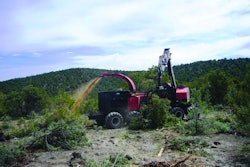
Rotochopper has modified its MC 266 mobile wood grinder to handle biomass. The 43,000 lb. MC 266 FP (Forestry Package) includes a pair of axles with super singles for extra ground clearance (a self-propelled tracked version is also available) and a large funnel-shaped mouth to feed branches into the long-wearing carbide tipped teeth.
The MC 266 FP uses a 475 hp Caterpillar C-15. "We found customers wanted something lighter and more maneuverable for biomass production," says Bergan. "They were also having difficulty getting material to the grinder to keep it busy, so we found this horsepower rating works well in getting wood to the landing efficiently."
As it has with cotton harvesting and gold mining, new technology will continue to be developed that will drive production costs down, helping to make better use of forest residue and other sources of biomass. Madison-area producers have time to gear up. The biomass boiler is expected to be online before the end of 2012, when it will provide steam for heating and cooling the University of Wisconsin campus.