
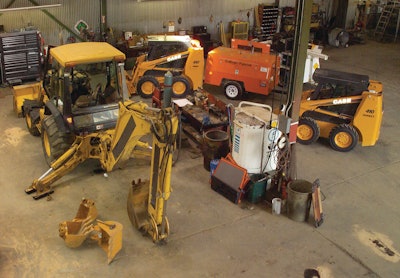
It's 6:00 p.m. Do you know where your heavy-duty equipment is?
According to the National Insurance Crime Bureau (NICB) from 2005, existing figures suggest that heavy equipment theft is getting worse. Some national surveys show that the amount could be as much as $1 billion annually in losses and indirect costs, such as project downtime and overrun penalties. Statistics compiled show that 72% of companies have experienced equipment theft in the past five years, and only approximately 25% of stolen equipment is ever recovered. That does not guarantee that the equipment is whole or undamaged, only recovered.
In a recent survey conducted by Cygnus Business Media in 2005, a typical theft victim had a 10% chance of recovery; 55% of the recoveries took over a week, and less than 35% of the equipment recovered was undamaged.
Heavy equipment theft is growing in popularity with thieves due mainly to the low risk factor. Often there is very little machine or on-site security protecting the equipment, and the high price tag on the equipment means a fast sell with a lot of profit for the thief.
"Some pieces of stolen heavy equipment end up in the hands of professional theft rings, or even in chop shops where they are stripped down to components that can be sold separately on the black market or are shipped overseas," states Kathy Kelleher, national manager, Commercial Div., LoJack Corp., Westwood, MA.
Unfortunately, there are job managers who are willing to buy stolen equipment for cheap in order to save money, and there are also unsuspecting contractors that don't realize they are buying stolen property. According to the National Equipment Register (NER), "If an item is recovered, an arrest may not be made. Where an arrest is made, a conviction may not be secured. Even where a conviction is secured, the penalty is likely to be light."
On top of that, most equipment does not have obvious unique indicators to separate it from other equipment. There is a PIN number, but many of the components on the equipment will also have their own unique PIN numbers which can make it hard to find and prove the equipment's identity. It also depends on how well the site manager is keeping tabs on the equipment. "Without registration or title documents, a theft victim may not have a record of the PIN or serial number, which is the key information needed to recover the equipment. If the owner has a PIN it may be a shortened version such as that on a warranty card or bill of sale that may not be a unique identifier. As there is no standard format for the numbering of heavy equipment, data entry error is common. …An incorrect PIN makes the report almost useless," states the NER.
Also to consider, a single piece of machinery stolen on a Friday night more than likely would not be discovered to be missing until Monday morning, unlike cars that are usually noticed to be stolen within hours. Owners or managers with larger fleets or multi-site operations may not discover the theft for days, weeks or months depending on the frequency the machine is used. The time lapse plays a major role in the ease of theft and difficulty of recovery of heavy equipment.
Hidden informant
Now, companies are fighting back by installing theft protection solutions into their equipment, or purchasing equipment that is already equipped with anti-theft. It is comparable to computers and spam blockers. People don't like to buy the added spam blockers; they expect the computer to come with the program already installed.
LoJack Corp. created the stolen vehicle recovery category over 20 years ago, and since has recovered more than 200,000 machines worth over $4 billion. The LoJack system is available in areas with a high population density, a large number of new vehicle sales, and the highest amount of vehicle theft. Currently, LoJack works in 26 states and the District of Columbia, as well as in 29 countries throughout Europe, Africa, Asia, and the Western Hemisphere.
LoJack provides several products to help protect equipment from being stolen, the LoJack Stolen Vehicle Recovery System (SVRS), the LoJack Early Warning Recovery System (EWRS) and LoCate (see sidebar on page 20). The SVRS system's core technology is based on proven radio frequency technology that is both highly effective and highly covert.
The LoJack system increases the chances of recovering stolen equipment to better than 90%. Around 68% of the recoveries take less than 24 hours, and more than 95% of the equipment recovered in undamaged, mostly due to the speed at which the equipment is able to be recovered.
When the machine is reported stolen, the hidden transmitter is automatically activated and tells the police exactly where it is, silently. The transmitter's radio frequency signal is even strong enough to penetrate through garage walls, steel containers, dense foliage and other places the thieves may try to hide the machine. This is an advantage over the use of GPS systems which require line-of-sight in order to find the stolen property's signal. There is a version of LoJack's system, the Ruggedized SVRS, made specifically for commercial vehicles and heavy construction equipment.
The EWRS notifies the owner directly if the equipment is moved outside of a predetermined parameter without proper authorization. The system can alert the equipment owner by phone, e-mail and/or pager.
The LoJack systems are the only stolen vehicle recovery systems operated by the police. LoJack's unique relationship with federal, state and local law enforcement agencies allows the software and databases to be directly integrated into each state's crime computers. LoJack's Police Tracking Computers are also directly installed in police aircraft and vehicles to be used in conjunction with the LoJack transponder. The LoJack staff also includes over 30 Law Enforcement Liaisons, all former police officers with a specialization in auto theft prevention.
Secrets, secrets
The transmitter is a small, silent radio transceiver that is hidden in the vehicle by a certified LoJack technician. All technicians go through background checks to ensure the system and process remains confidential and covert — no exceptions. The units are never installed by the company's technicians, considering many thefts happen from workers who know and understand how to work the equipment, how frequently the equipment is used, the security of the job site, among other important information.
Once the transmitter is installed, the unit is automatically registered in the LoJack database that is directly interfaced with the National Crime Information Computer (NCIC) system used by federal, state and local law enforcement agencies throughout the country. One person, usually the equipment's owner, rental service owner, or whoever would see the loss should the equipment get stolen, is the only person to receive the LoJack system's unique code that matches against the state VIN database.
When a piece of equipment is discovered to be stolen, the owner reports the theft to the police and the LoJack code is matched to the unit hidden within the equipment. The process of searching the database for a match automatically activates the unit to allow the machine to be tracked.
No images are released as to what the unit itself looks like. No one but the LoJack technician that installs the unit knows what it looks like or where it is located on the machine. Even the owner with the unique LoJack code doesn't know anything about the shape, look or location of the actual unit. What LoJack does disclose about the unit is that it is a self-contained, one-piece unit (approximately the size of a deck of cards) that allows for easy concealment and mounting location flexibility. The system features a sealed, waterproof, dust-proof and chemical resistant enclosure that meets SAE design standards for heavy-duty vehicles. It operates on a 12 or 24v battery source. LoJack continually recharges itself from the vehicles electrical system, but should the vehicle battery get disconnected, the LoJack transponder's internal, long-life backup battery provides power.
The unit can be hidden in a multitude of different locations, so there isn't a standard hiding place; each individual LoJack transceiver is disguised uniquely in each machine. There is also no noticeable marking or other way to tell that the machine has been outfitted with the LoJack SVRS, so thieves won't know they are being tracked until it's already too late. The system is not meant to be a deterrent by itself, it is meant to quickly and safely recover stolen equipment and bring justice to the thieves and theft rings stealing the equipment.
This amount of secrecy allows the utmost effectiveness with the system and prevents even the most knowledgeable thief from A) finding the hidden unit to dismantle, and B) achieving a successful theft of the machine to make a profit.
Insurance is not enough
As many construction companies soon find out after the theft of a machine, there are hidden costs that stretch beyond vehicle replacement costs. There is the cost of replacing the extra contents in the machine, lost cargo and onboard equipment, and rental costs. The premium renewal increases and insurance deductibles can be a surprise cost that most wouldn't consider. If the equipment is found and returned, there is the cost of repairs for damage to the machine. And of course, the layers of costs that come with additional project downtime for both the equipment and crew causing a loss in total revenue and can sometimes lead to potential contractual penalties or the loss of the project altogether.
Cygnus' 2005 survey found that "23% of contractors who had suffered equipment theft had to extend their time on construction projects because of loss of productivity. 35% said that the loss of equipment had increased operating costs because of the need to hire security guards and add fences or gates to their jobsites. And 45% said they had lost money because of contract penalties or as a result of stolen equipment being uninsured or under the coverage minimum."
According to Michael Donsky, a LoJack law enforcement liaison in Florida, "From the moment a contractor loses a piece of heavy equipment to theft, the clock starts running on all the other costs of the crime, including replacement or rental costs, insurance premium increases, crew downtime, lost revenue and potential contract penalties."
Now that there is the proven, reliable technology available to protect and recover stolen equipment, the demand for that option is growing. With heavy-equipment being such a large investment, it makes sense to protect it. The level of secrecy and security provided with the system, including background checks on every LoJack engineer and any OEM engineer involved with the installation, means that equipment is always in safe hands.
The LoJack system allows the equipment owners to live a little more dangerously. A completely hidden, stealth tracking device that not only protects and recovers equipment, but helps catch the thieves themselves. Call it the James Bond of the heavy-duty equipment industry.
![[WEBINAR] Eliminating Integration Friction with a Single-Source 48V Power System](https://mindful-org-acbm.imgix.net/workspaces/default/uploads/2026/05/oem-ad-briggs-and-stratton-vanguard-ns-25983-1600x900-v1.SCpxqTXzuP.jpg?auto=compress%2Cformat&fit=crop&h=100&q=70&w=100)

![[WEBINAR] Eliminating Integration Friction with a Single-Source 48V Power System](https://mindful-org-acbm.imgix.net/workspaces/default/uploads/2026/05/oem-ad-briggs-and-stratton-vanguard-ns-25983-1600x900-v2.nSoFLhvSeL.jpg?auto=compress%2Cformat&fit=crop&h=100&q=70&w=100)

![[WEBINAR] Eliminating Integration Friction with a Single-Source 48V Power System](https://mindful-org-acbm.imgix.net/workspaces/default/uploads/2026/05/oem-ad-briggs-and-stratton-vanguard-ns-25983-1600x900-v1.SCpxqTXzuP.jpg?auto=compress%2Cformat&fit=crop&h=167&q=70&w=250)

![[WEBINAR] Eliminating Integration Friction with a Single-Source 48V Power System](https://mindful-org-acbm.imgix.net/workspaces/default/uploads/2026/05/oem-ad-briggs-and-stratton-vanguard-ns-25983-1600x900-v2.nSoFLhvSeL.jpg?ar=16%3A9&auto=compress%2Cformat&dpr=2&fit=crop&h=135&q=70&w=240)


