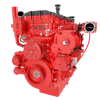
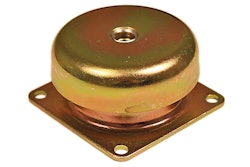
Shock and vibration in off-highway equipment can create a number of problems, from annoying rattling, to accidental storage compartment opening, to complete latch failure. The sources of these problems include extremely rough terrain, continuous operation of heavy-duty diesel engines, and intermittent vibration caused by auxiliary units installed on the equipment such as pumps, compressors, compactors, pile drivers and boring equipment.
Yet, regardless of the source or effects of that shock or vibration, the key to finding successful access hardware and fastener solutions to combat them is in understanding the nature of the force and identifying appropriate designs to handle it. This holds true in applications with cyclic loads that vary in frequency and amplitude, as well as those with a sudden acceleration in force in one axis or several.
Establishing the parameters
The effects of shock and vibration vary widely by the type of off-highway vehicle and the axis of force — fore/aft, side-to-side, or vertical. For example, the average fore/aft acceleration forces for back hoes and excavators (2 Gs) and excavators (2.5 Gs) are similar to those for off-highway trucks (3 Gs). However, the maximum fore/aft forces experienced by off-highway trucks (10 Gs) are two to three times higher than the maximum forces for backhoes (3 Gs), excavators (4 Gs), and on-highway trucks (4 Gs). Also, vertical acceleration forces typically exceed the fore/aft and side-to-side acceleration forces as a result of rough terrain. Having an idea of the magnitude of forces experienced in an application is the first step to specifying an appropriate solution.
Addressing the need
Once the shock or vibration problem is identified for the specific application, compare load ratings to identify more robust latch designs, or use multiple latch points to distribute the load. Gaskets can be used too dampen vibration, or modify the position of latches on the door to change the angle of the shock or the harmonics of the vibration. The size, weight, or shape of the door may also be adjusted to minimize torque forces on latches and hinges. For less critical applications, simply specifying a safety factor using a higher than normal multiplier of the static load rating for a particular latch or hinge mechanism might be acceptable.
For more complex applications — including those with sudden extreme shock or impact — consult with a hardware supplier about defining anticipated load forces, frequency of vibration and impact shock.
Consider convenience as well as safety
Nut-and-bolt fastening — using locknuts, lockwashers, or crown nuts with cotter pins — is certainly one way to ensure secure attachment of small components, accessories or panels in high-vibration applications where a full-size latch is impractical or unnecessary. But the time and effort to remove that type of fastener hardware for repetitive routine access, maintenance, or service can really dampen end-user satisfaction. Fortunately, there are other cost-effective options for promoting the convenience of quick-access without compromising shock- or vibration-resistant performance.
For lightweight compartment doors, swell latches provide a rubber bushing that expands when compressed by turning a wing nut or flipping a handle. That expansion creates the mechanical grip necessary to hold access panels fast, and provides a degree of shock absorption.
For heavier access panels, protective covers or noise-suppression panels in off-highway equipment, vibration-resistant quarter-turn fasteners reduce maintenance time and maintain consistent tension.
Numerous designs are available to provide varying degrees of economy, strength, and vibration-resistant performance that satisfy a wide range of requirements. Many of them have already proven their capabilities in demanding applications ranging from aerospace to high-performance automobiles to Class 8 trucks. (Figure A.)
Other high-strength, quick-access fastener hardware for off-highway applications includes quick-release pins which can be used for everything from pegging adjustable supports to anchoring loose chocks in storage. These pins — available in standard sizes up to 1 in. and shear strength ranging from 4,000 to more than 100,000 lbs. — use a variety of detent ball designs to provide positive pin retention with tension load capacities from 200 to 5,000 lbs.
Accommodating exceptional forces
Reconciling extreme shock forces, compound forces from multiple directions or vibration that varies in frequency or intensity poses special challenges in off-highway designs. That is why designs utilizing gaskets or special compounds play a big role in off-highway designs.
Specialized draw latches made from thermoplastic elastomers that can withstand heat, UV exposure, flexing, and extreme loads, provide the performance characteristics needed for applications like hood latches and engine covers. (Figure B.) That allows them to tolerate the stretching, flexing, and twisting forces between a vehicle’s chassis and body panels as it navigates rough terrain under a full load.
In extreme situations — like a 3,000 hp mining truck — choose access hardware designed to minimize the effects of vibration. For example, compression latches used in conjunction with compressible gaskets can compensate for external forces and variances in alignment when used for access doors and storage compartments, especially those where a consistent seal is desired to keep out dust or moisture. (Figure C.)
Also, using hardware with over-center latching action can provide greater resistance against accidental opening under extreme vibration conditions than other types of latches.
Documenting proven solutions
For the most extreme or crucial applications, specific product testing in the lab or in the field might be an appropriate choice in determining proper hardware selection. A standard fatigue-testing rig that uses a load cell in the linkage between a hydraulic actuator and the latch plate can impart repetitive loads to latch hardware to help establish benchmarks for various product configurations.
Laboratory testing has demonstrated that the difference between a medium-duty and a heavy-duty latch of the same design can range from two to six times higher in cycle life at an applied load of 0 to 0.5 kN. That same testing also showed that by changing the cam design on the heavy-duty latch, cycle life could be improved by four to six times — up to a total of 10 million load reversals — at an applied load of 0-1 kN and a frequency of 10 Hz.
That type of documented testing demonstrates the value of working with an access hardware manufacturer experienced in designing and testing appropriate products to match custom requirements.
Steve Potter is the business development manager, off-highway for Southco Inc.