Operations in the mining industry cannot make a move without mobile equipment. But traditional maintenance approaches sometimes stalls productivity in its tracks.
Mobile equipment represents one of the largest capital expenditures in a mine, and can account for up to 70% of the total maintenance budget. Contributing to this high cost is the industry's long-time reliance on time-based maintenance, where equipment is removed from service for inspection and maintenance whether it needs it or not.
The resulting downtime and unavailability of equipment curbs productivity. In addition, time-based maintenance is unprepared to detect premature or "random" failures and may even cause problems down the road due to improper or inappropriate service procedures.
All the pitfalls associated with time-based (basically preventive) maintenance strategies have long been viewed as problems in search of solutions. The light at the end of the tunnel: Advanced condition monitoring systems — onboard and on-line — engineered specifically for mobile mining equipment.
Unearthing applications
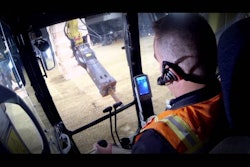
These systems elevate "fault detection" to new heights. The technology (hardware and software) enables the condition of mechanical components to be monitored while equipment is actually in operation, when data can then be communicated for analysis and, if appropriate, remedial action.
This proactive approach to maintenance eliminates the detouring of equipment for time-based inspections, thereby increasing its availability. Vehicle reliability is enhanced, too, because suspected problems can be identified in real time for prompt, corrective action before a catastrophic failure can occur.
The numbers tell a compelling "capital" story that drills down to core bottom-line benefits:
Using on-line fault detection systems, it has been estimated that predictive maintenance can increase equipment availability up to 3%. The increased availability, in turn, can help reduce fleet size, because redundant vehicles need not be dedicated to pinch-hit. With a purchase price for a new truck in the range of $1.5 million to $3 million, the potential savings drive home.
For mining operations well under way with periodic monitoring procedures using permanently installed sensors and hand-held data collectors, an on-line system can transport the process to higher ground. Measurement accuracy improves and random events can be caught in time.
Mining operations can readily apply on-line condition monitoring to a wide range of mobile equipment components. Among them:
- Large haul trucks, miners, loaders, dozers, and excavators: Engine, transmission, cardan shaft, differential, alternator and final drive
- Shovels: Hoist, crowd, swing and propel mechanisms
- Bucket wheel excavators and stacker/reclaimers: Conveyors and bucket supports
- Draglines: Hoist, drag and swing mechanisms
- Drills: Drillhead
- Auxiliaries: Motors, pumps, fans, blowers and compressors
Inherent challenges
These systems monitor key operating parameters such as vibration, temperature, speed and load conditions. For equipment "on the move," though, systems must be equipped to deal with a variety of inherent challenges.
For one, mining vehicles travel or operate at varying speeds. This means that a meaningful condition monitoring system should incorporate software with conditional "gating" (or measurement logic) capabilities to capture data under varying conditions. Using a "time window," the gating can govern when measurements would best be collected under specific conditions (such as speed and load) for enhanced accuracy and reliability.
Example: When a vibration measurement is to be collected, the system should be engineered to determine whether the speed signal is within the interval preset for this measurement. Then, only if the speed condition falls within the appropriate window will the measurement be collected for best interpretation.
The harsh environments and operating conditions associated with mining operations pose yet another challenge. System hardware (including sensors) must be rugged, provide high shock and over-voltage protection, and should be able to resist abrasion and high fatigue. With relatively limited space onboard, all elements of an onboard system should be designed with compactness in mind.
Perhaps the most obvious roadblock to making on-line systems a reality is the "wiring" problem before the days of wireless. Today, of course, wireless networks are commonly used within the mining industry, and onboard on-line condition monitoring technology has kept pace. When selecting a system, however, users should be certain that it will be able to communicate with the operation's existing wireless network.
Technology profile
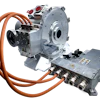
SKF Copperhead for mobile mining equipment exemplifies how far onboard and on-line condition monitoring technology has traveled in the past few years in meeting the off-road challenges.
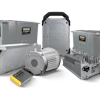
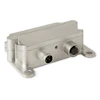
Each sophisticated onboard modular monitoring system — complemented by rugged, low-profile sensors — allows for 16 analog inputs, two digital inputs, and four relay outputs for onboard alarming. Housing is compact (310mm x 265mm x 110mm) and built using integrated printed circuit board construction (instead of slotted cards that could loosen from vibration). A specially developed aluminum case allows for effective cooling to 85 C (205 F) and an optional IP66 enclosure can be specified for extreme conditions.
Robust system software features a unique "gating" algorithm to capture data under varying conditions; complete spectrum analysis, including SKF's Acceleration Enveloping analysis; multiple automatic alarm settings per channel; hierarchical and process interface views; and an ability to communicate with Decision Support and Computerized Maintenance Management Systems (CMMS) to take advantage of automated fault diagnostics and expert recommendations for corrective action.
The software can monitor up to 100 modular systems in multiple vehicles simultaneously; can send SMS and e-mail messages; and can be Web-connected for remote monitoring.
Cases in point
Onboard on-line condition monitoring systems have made significant inroads as customer experience attests:
- A system for a large haul truck monitors 16 different points for vibration. Random faults have been detected in the cooling fan and cardan shaft and automated diagnostics saved analysis time and accelerated repairs for the truck's quick turnaround back to service.
- A hoist transmission of a giant shovel has been fitted with a system that recently detected a fault in a motor well before extensive damage and unscheduled downtime could occur.
All such applications clearly underscore how continuous condition monitoring can increase productivity and streamline maintenance for mobile mining equipment. These systems go even further by promoting operator safety and a "peace of mind" that rides with the verified knowledge that equipment is functioning as intended.