Some original equipment manufacturers are re-engineering traditional vehicle hydraulic systems with intelligent electrical systems that reduce complexity and improve performance. Non-hydraulic or electro-hydraulic systems are inherently clean, quiet to operate, efficient and allow for more ergonomic design and less complex installation during the manufacturing process.
A natural consequence of the electrification of vehicles is the switch from standard hydraulic steering to all electric, or by-wire, steering systems. In many of these applications, tactile feedback devices (TFD) for by-wire steering systems are gaining acceptance with design engineers who are seeking solutions to today's trends: adopt vehicle designs based on electrical technology while maintaining the operator/machine interface that can mimic the feel of traditional hydraulics. In by-wire-steering systems, sensing of the steering command is required; however, many engineers are finding that safety and control are enhanced with controllable steering feedback.
These engineers view tactile steering feedback as a requirement in any by-wire implementation since it allows the operator a heightened sense of vehicle control and improves safety in operation. So, how does one get started in applying steer-by-wire systems to tomorrow's designs without starting from scratch? The key to success is identifying industry suppliers who are leaders in by-wire implementation and by applying lessons learned from other applications in order capitalize on the benefits of by-wire systems.
By-wire basics
Without the traditional mechanical steering link, developers of by-wire controls found early on that the loss of tactile feedback often results in a degradation of control via over or under steer, thus compromising safety and reducing productivity. To overcome this problem, a controllable and proportional force feedback device is connected to the operator steering control to produce useful tactile information, often mimicking the feel of the conventional system being replaced. The controller is programmed with a tactile feedback algorithm that modulates torque feedback to the operator as a function of steering wheel rotational position, velocity, acceleration, steered wheel position, vehicle speed, or other parameters — singly or in combination.
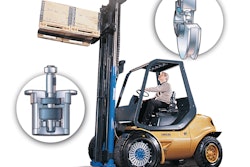
It is less expensive for an OEM to route wires than hydraulic hoses and from an ergonomic standpoint, reduced effort, variable rate/ratio steering can have the benefit of reducing whole arm and wrist fatigue that can occur from operating traditional multi-turn steering. By-wire steering is a great advantage in "man-up" vehicles where the operator is hoisted up to manually pick stock from high racks in the warehouse because it eliminates complex telescoping mechanical steering linkages.
Incorporating tactile feedback with steering sensing provides the option or possibility to communicate information to the driver regarding vehicle conditions. For example, tactile pulsing (high torque to low torque) while turning the wheel may indicate a vehicle fault or increased steering effort may indicate a vehicle obstruction. Vehicle warning systems, enstops (end of travel indication), and variable friction or variable steering effort (depending on machine mode of operation) provide more precise control by minimizing the possibility of oversteer/understeer and offer improved safety by providing more precise vehicle control. Furthermore, product standardization around common by-wire controls may decrease the cost associated with operator training and common vehicle interfaces can be adopted more easily.
Market need
According to Dr. Markus Plankensteiner, consortium coordinator for the TTA-Group (TTA is time-triggered architecture), the time is right for the development of reference architectures for on-road use. The TTA Group, a cross-industry consortium for dependable time-triggered systems, is working to develop such architectures for by-wire systems without mechanical backup for on-road use. The objective of the TTA-Group is to develop a global guideline to enhance reliability, interoperability and safety of steer-by-wire systems, which should lead to faster adoption and higher cost efficiency for suppliers and OEMs.
"One of the biggest challenges and hindrances to growth and acceptance has been the cost, or perceived cost, of steer-by-wire," says Plankensteiner. "The goal of the working group is to optimize and to facilitate technology development on the platform level to minimize costs. This will result in higher cost efficiency for suppliers and manufacturers."
If growth in the TTA-Group is any indication, the interest in TTA-Group's activities is high. More than 20 companies and organizations have teamed up in the steer-by-wire working group to gain competitive advantage together. Manufacturers and suppliers of leading tractor, construction machinery and forklift industries have committed significant resources to cooperate on development of common platforms.
Danaher Motion also recognizes tremendous market potential in steer-by-wire systems and has responded with the development of intelligent, seamless systems to replace current on-board hydraulic systems.
According to Peter Taube, Danaher Motion system engineering manager for electrical vehicle systems, a variety of factors are impacting the growth of by-wire systems, and as a general trend, by-wire systems will become smaller and lighter. A proven solution in the fork lift industry, there is potential for by-wire systems in new applications, such as the lawn mower market because of the benefits of removing hydraulic oil from the machine. The interest in hybrid systems also will drive the growth for by-wire, says Taube, as will the passenger car trend toward electric steering.
Tactile feedback
Steering tactile feedback based on proportional Magnetically Responsive (MR) technology has applications ranging from OEM lift truck manufacturers and marine propulsion companies; the technology is no longer experimental. MR-enabled devices offer advantages over other types of torque-generating devices. MR feedback produces smooth torque with no stick-slip or cogging. Power consumption on electric vehicles is a huge concern. More energy efficient means extended machine run time, less recharge cycles , and extended battery life. Steering devices engineered with MR technology are smaller and consume less power.
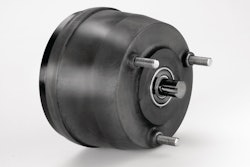
As a design engineer, it is crucial to understand the components and how they come together. For example, some suppliers bundle the components for tactile feedback devices (TFD) by integrating all of the necessary hardware for the operator interface — force feedback, position sensing, shaft and bearings — in a single plug-and-play device, eliminating duplication.
The customer also has the benefit of sourcing all of these functions from a single supplier. Comprehensive "all in one" units, which include the sensing and feedback, may eliminate the conventional steering column by permitting a direct attachment of the steering wheel to the TFD. Environmental considerations include Industrial Protection (IP) rating, salt spray/corrosion, sensing requirements (Input/Output requirements for vehicle controller and redundancy), as well as feedback (torque range required).
Lord Corp. offers TFDs in a product family approach, which results in improved economies for customers of all sizes. Lord collaborated with sensor suppliers to standardize an encoder package that is flexible and cost-effective, and it offers a variety of resolutions and redundancies. Since the Lord TFD, in typical applications, is mounted directly to the steering wheel, the devices are built to withstand normal steering loads without the use of secondary columns, couplings or shafts. This integration enhances implementation with customers and eliminates components. Further, the product families are engineered around two nominal torque ranges that serve as the "center" point for each product family — 5 N-m and 12 N-m. In real world applications, these nominal torques have proven to be both popular and effective.
There also are many off-the-shelf products available today to aid in by-wire system design efforts. For example, Danaher Motion has developed two products that are easily integrated in today's vehicles. Danaher Motion's Advanced Power Steering (APS) consists of a PM AC motor with integrated speed reducer and an AC drive. It interfaces directly to the sensors of the steering system and may operate stand-alone or in a CAN network. The product range covers most applications, from large Class 1 counter balanced trucks to small Class 3 trucks, and is suitable for replacing electrical and hydraulic steering systems. The APS communicates via the industry standard CAN-Open protocol.
The Direct Drive Steering (DDS) product from Danaher Motion is a ready-to-go product for design engineers to consider. The system only runs when steering, so the overall efficiency is substantially higher in comparison to traditional hydraulic steering systems. The flexibility provides for free placement of input devises such as steering wheels, multi-turn wheels, joysticks and wire guidance components. For design engineers, the reduced part count of the electrical steering system results in less wiring, easier assembly and decreased warranty issues.
Key to success, however, is for design engineers to have an open mind. According to Dwayne Roark, manager of marketing communications (North America) for Danaher Motion, there is a misconception that by-wire systems are still experimental, and still expensive. However, he says, as the adoption rate increases, the costs will continue to decrease. And, the technology is proven. There are examples of by-wire systems in place for more than 20 years on 20-ton tractors for forestry applications.
According to Benny Forsman, a vertical market manager for Danaher Motion, design engineers benefit most when they approach a by-wire system with an open mind in order to capitalize on its benefits. For example, a hydraulic system requires a pump in the steering column as well as integration of the hoses into the design. In contrast, an electric system simply has wires, resulting in greater design freedom and space, as well as new possibilities in terms of layout and performance of components.
Getting to market quickly
Given the possibilities of by-wire enabled systems, the next step is the integrated design and development phase. Whether you are in the conceptual or prototyping stage, it is crucial to select a component supplier that knows your business and is truly interested in tailoring a solution for your application. Ask your supplier how they can assist you in getting to market sooner and becoming more profitable. For example, what is the best approach to combine a shaft, column, torque unit, and sensor all in one in order to eliminate components and create an integrated unit? Balancing such variables requires expertise in order to adapt a solution for your needs.
Another crucial consideration is selecting a supplier with a track-record of delivering high quality and high performing products since the systems are often integrated into or near safety critical applications. For example, look for a partner with an appreciation for design validation and application-specific life testing. Further, it is important to ensure that your supplier has the ability to test extensively in order to certify the product for any applications.
Timing also is key. Selecting a supplier that has the resources to ensure a successful launch of your application is paramount. While vendor certification and qualification programs often uncover such discrepancies early in the development cycle, selecting a development partner with a long history of manufacturing and innovation will greatly minimize your risks. Be sure to ask your supplier for examples of past production launches and their schedule, as well as how any development challenges were overcome. Be cautious of any supplier that only has one option for your unique application. By partnering and collaborating with a supplier with an extensive portfolio, you'll also benefit from benchmarking and value engineering — ensuring a custom solution without having to start from scratch.
Preparing for the future
If the diversity in end-use applications is any indicator, the acceptance of tactile feedback devices for by-wire systems will continue to grow, not only as a means to improve safety but also to improve operator comfort and convenience. However, since these components are safety critical, it is important to partner with a supplier that offers a variety of solutions as well as the resources and expertise to test and validate your application.
Doug LeRoy is a market manager for Lord Corp.'s MR Solutions business unit.