Traditional internal combustion (IC) engine combustion simulations involve computational fluid dynamics (CFD) models that use a simplified chemistry representation for fuel combustion. The chemistry included in the models ranges from just a few molecular species to about 50 species for diesel fuel, for example. For conventional diesel and gasoline engines, these approaches have historically been good enough, because the fluid-mixing effects dominated the chemical kinetics effects in predicting engine performance.
New engine designs present new simulation challenges
New, high-efficiency, low-emissions designs present technical challenges are highly influenced by kinetics (e.g., dual-fuel engines, staged spray injections for improved efficiency, premixed charge compression ignition (PCCI) combustion, low temperature conditions, etc.). What proved to be good enough for the design of yesterday's engines is insufficient for today's designs. A consistent failing of current CFD codes, as cited by the industry, is that it cannot be relied on to predict values or even to project accurate trends of critical combustion behaviors such as ignition, flame propagation and emissions.
This issue is exacerbated by the fact that the fuels landscape continues to evolve and become more complex. Where yesterday’s engines were designed for a single fuel type, such as diesel or gasoline, today's engine specifications demand fuel flexibility while achieving even lower emissions than in the past.
The Model Fuels Consortium (MFC) is an industry-led program, currently in its sixth year, which has developed both the detailed chemical mechanisms and the tools required to simulate real fuel behavior. While the MFC has been exceedingly successful in developing fuel mechanisms that accurately simulate real fuel chemistry, it has proved the impracticality of reducing these mechanisms to the point that they can be incorporated into contemporary CFD simulations without a substantial loss in accuracy. MFC researchers have recognized that the focus should shift from trying to get reliable results with mechanisms so severely reduced that they cannot capture real fuel behavior, to enhancing the ability of simulation tools to use mechanisms with the necessary level of detail.
A Dept. of Energy (DOE) scientific laboratory recently acknowledged the critical role that advanced simulation has in developing engines for reduced greenhouse gas emissions in a white paper entitled: “Predictive Simulation of Combustion Engine Performance in an Evolving Fuel Environment.”1 The paper points out that engine manufacturers must move to “change from a test-first culture to an Analysis-Led Design Process” and that “a predictive simulation toolkit would accelerate the market transformation to high-efficiency, clean power sources for transportation.” Kinetics is recognized as a critical area for advancement supporting the design of clean, fuel-flexible engines that reduce greenhouse gas emissions.
Spray modeling
Another key area of concern in engine simulation has been spray modeling. The choice of the spray model can have a significant impact on a simulation’s time-to-solution and accuracy of results. Most of the spray models used presently are highly mesh dependent, which requires that valuable innovation time be spent on calibration versus experimental data or adding complexity to the mesh to find an acceptable combination of spray-model parameters and grid. Understanding how to do this calibration requires specific expertise and makes it difficult for widespread utilization of a predictive CFD methodology across the organization.
The lack of reliability in combustion simulations is likely caused by a lack of detail in the way the fuel-spray and combustion kinetics are represented. Because the industry has been limited in the amount of chemistry detail it could practically incorporate into a CFD simulation, work has focused on turbulence-mixing phenomena, use of approximate combustion models and meshing. But, because of the increasing challenges in today’s engine design environment, attention is now focused on improving the quality of the modeling of the spray and kinetic phenomena.
How engine designers address the challenges today
The dominant way designers have dealt with time-to-solution issues over the last five years was to simply buy more CPUs and use severely reduced fuel kinetics to get a solution in a reasonable amount of time. Unfortunately, the inherent solution complexity and numerical stability limitations of conventional CFD approaches prevent the use of larger, more accurate chemistry mechanisms. These approaches worked for conventional engine designs by relying on vast amounts of empirical performance data, but these data do not exist for current novel engine designs.
Some in the industry claim that predictive results are not achievable without extensive model calibration. Extensive data must be available to “tune” the simulation model, however, the data gathered may not extrapolate to engine operating conditions that were not or could not be directly tested. Because of these difficulties, combustion simulation is sometimes avoided completely and non-reacting simulations are used to identify parameters such as local fuel/air ratio or spray distribution. These parameters are used to indirectly infer the effects on combustion performance.
A new approach: achieving accuracy by modeling real fuel chemistry
These challenges have to be addressed to allow the engine industry to use simulation for competitive advantage. For advanced-concept engines, chemical kinetics takes a front-seat role in controlling ignition behavior, as well as emission and knock performance. Managing uncertainties in fuels and fuel composition requires use of a high-fidelity fuel model in design calculations.
Powerful chemistry solutions
The barrier to good fuel representation in CFD simulations is not the lack of information about the detailed chemical kinetics of fuel combustion. There has been huge growth in the understanding of the combustion behavior of liquid transportation fuels over the last decade through work validated by the MFC program. The MFC developed detailed, molecule-based kinetics representations of the important fuel components for conventional and alternative automotive fuels. Consortium researchers showed that sufficiently accurate fuel models can capture details of fuel ignition, flame propagation, pollutant emissions, particulate formation and engine knocking, as well as the effects of fuel variability and multi-fuel strategies.
Results demonstrate both quantitative and qualitative prediction of combustion behavior, as seen in Figure 1, where a reduced mechanism with approximately 100 species is compared to a more accurate mechanism with 428 species. Experimental data are represented by the solid triangles. The larger mechanism is shown to have the necessary accuracy required to provide excellent prediction of emissions values and trends.
Can you get accuracy in combustion CFD with reasonable solution times?
Time-to-solution has been a key barrier to employing sufficient chemistry detail in CFD calculations. As most commercial CFD improvements directed toward increased accuracy have focused on enhanced meshing and turbulence modeling, there has been little effort directed toward improving the fundamental chemistry calculations. Given that chemistry calculation times in CFD can account for as much as 90% of the total simulation time even when severely reduced mechanisms are utilized, there is a substantial opportunity to decrease time-to-solution by accelerating these calculations.
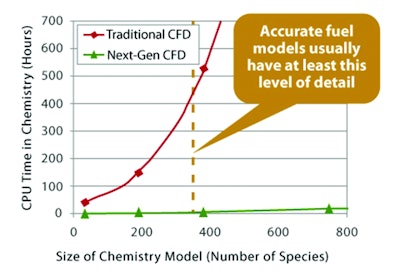
Reaction Design’s CFD package, called FORTÉ, employs a novel solver approach that takes advantage of the chemical similarity of groups of cells and implements a parallel processing algorithm to dramatically reduce the chemistry calculation time. This technique can reduce simulation run times by almost two orders of magnitude, as demonstrated in Figure 2. Chemistry models that previously were thought of as only practical for 0-D simulations are now practical for full 3-D engine simulations complete with moving pistons and valves. With innovative approaches to relieving the bottleneck in chemistry calculations, predictive engine simulation is now a real tool that can be harnessed for competitive advantage.
1. “Predicting Simulation of Combustion Engine Performance in an Evolving Fuel Environment,” US DOE Sandia White Paper, submitted by Robert W. Carling, February 25, 2010.
William Kuykendall is a field applications engineer with Reaction Design. He has spent his career providing engineering services and support for combustion simulation software.