It began with what seemed to be a simple leaf spring issue on the MX engine’s turbo support. Flagged by DAF’s test department, DAF’s in-house CAE-Engines team in Eindhoven, the Netherlands was asked to investigate. It was their job to simulate the issue and figure out a viable design for the existing operating conditions. Using LMS Virtual.Lab Motion and LMS Virtual.Lab Noise and Vibration, they not only discovered what was wrong and how to fix it, they also found out that the actual structure wasn’t optimal. The final result? A time and money saving revelation that will improve the next-generation MX engine.
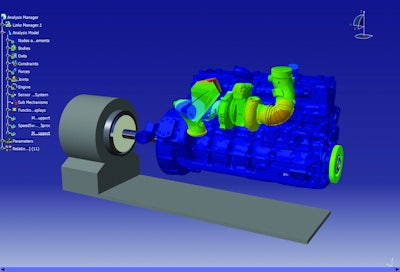
The easy part of the job was discovering the root cause leading to the undesired behavior. It turned out that high acceleration rates on the MX’s turbo unit and high thermal expansion caused overloading of the leaf spring. Something that the test data alluded to, but the work in LMS Virtual.Lab took the process a step further: it explained how to fix it optimally. “We’re not like an automotive OEM where you have teams of people working on specific issues. The six of us are pretty much an engineering services center for the engine development department. Jarno Lathouwers, our LMS Virtual.Lab specialist, developed a model to virtually replicate the engine test bench for the next-generation MX engine. Working virtually allows us to develop different engineering scenarios to present clear-cut design options to our managers –without the time and expense of putting it on an actual test bench. It is a leap ahead in the development process,” stated Eric van Velthooven, the team’s supervisor.
During the simulation studies on the virtual test bench, Jarno Lathouwers noticed that the concept of the leaf support wasn’t optimal, and redesigned it in LMS Virtual.Lab Motion. Developing the leaf spring support in different ways really affected the overall engine vibration performance. With validated LMS Virtual.Lab simulations, he could see exactly which solution was the right one and why it worked. The added value is not only in reproducing tested behavior but in understanding the mechanisms behind potentially undesired behavior.
Beyond the leaf spring design
DAF already converted to LMS Virtual.Lab Motion some years ago. And like many other companies, they were eager to discover exactly how they could use the LMS Virtual.Lab platform to improve their process. The CAE Engines team uses LMS Virtual.Lab Motion to analyze engine dynamic behavior in the time domain using engine models with both rigid (CAD) and flexible (FE) components for more dynamic model content. In addition, they also acquired LMS Virtual.Lab Noise and Vibration for in-depth engine forced response analysis in the frequency domain. One of the key benefits of this combination – LMS Virtual.Lab Motion and LMS Virtual.Lab Noise & Vibration - is that the frequency domain load input can be derived directly from the time simulation results carried out in LMS Virtual.Lab Motion.
It led the team right to the possible source. On top of that, LMS Virtual.Lab Noise and Vibration lets the team easily incorporate and post-process results from DAF’s test department. With dynamic models created in LMS Virtual.Lab, the engineering team could create possible ‘what-if’ design scenarios on a virtual test bench and use these development scenarios to guide internal design decisions.
“For most issues, every involved engineer will propose a solution and most of the time, they are all different. When you have a tool like LMS Virtual.Lab, you can quickly validate or rather invalidate various design options and easily support your arguments for solving a certain problem in a certain way. With LMS Virtual.Lab, you can see the full calculation and relevant data and know that your total result works,” stated Eric van Velthooven.
This doesn’t mean that testing is a thing of the past. After a particular optimized configuration is selected using LMS Virtual.Lab simulation, it is validated using test data acquired using the LMS Test.Lab platform and LMS SCADAS hardware. Then the DAF project team manufactures the prototype piece and mounts it on the engine and runs the tests on the actual prototype to validate the solution as a whole.
Driven by emission standards… and cost
Regarding engine development, most recently the next-generation MX engine, DAF faced the typical challenges that every engine developer faces today: new stricter emission regulations, customer demands for better fuel efficiency and reliability and, of course, keeping the engine cost as low as possible. All these changes affect not only the engine itself, but also how the engine interacts with the various truck models as a whole.
If one considers the fact that the DAF CAE-Engines team completes an average of 150 CAE-jobs per year, this represents a superb cost-saver that LMS Virtual.Lab contributes to.
“We are dealing with extremely complex engine designs and our deadlines are tight. You can easily imagine that the pressure is on and the stakes are high. Add in the global economic crisis and it is clear that we have to be faster and smarter with the tools and people that we have. From this point of view, LMS Virtual.Lab is an ideal tool for the tough times,” concluded Eric Van Velthooven.



![Deutronic Dbl 1903 14[1]](https://img.oemoffhighway.com/files/base/acbm/ooh/image/2023/10/Deutronic___DBL_1903_14_1_.6528568875a4e.png?auto=format%2Ccompress&fit=crop&h=100&q=70&w=100)