A new torque control system, derived from technology developed to win the gruelling World Rally Championship, has been shown to substantially improve the productivity, safety and running costs of large off-highway vehicles working on low-grip surfaces. Developed by motorsport and engineering consultancy Prodrive, the system adds electronic control to the vehicle’s existing differentials to deliver a substantial improvement in performance at a cost-effective price.
A large, heavily laden off-highway vehicle descending a slippery slope can present a substantial challenge for the driver: locking the differentials will improve braking performance but the ability to steer is greatly reduced; unlocking them restores steering authority but compromises braking. Climbing a slippery slope is equally difficult as the driver has to juggle the differential controls to switch between traction and steering. Even with the most highly trained personnel, wear on the driveline and tyres is increased and the potential safety issues associated with guiding a substantial vehicle with compromised steering, braking and driver concentration are significant.
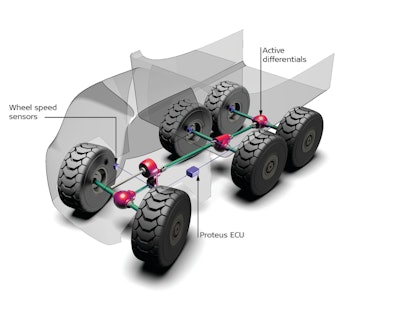
Prodrive’s solution, called ATD (Active Torque Dynamics), is based on a proprietary algorithm that controls the differentials; optimising the traction at each wheel. ATD is compatible with most lockable differentials so as well as being suitable for new vehicle programmes, it can also be retro-fitted to existing vehicle types and even to vehicle fleets in-service.
In normal conditions, differentials allow wheels on the same axle to rotate at different speeds, enabling a vehicle to turn. However, if one wheel meets an area of low friction, this wheel can lose traction and spin taking drive away from the wheel that still has grip. As a result there is little or no driving force from this axle. By locking the differential both wheels are forced to rotate at the same speed enabling the wheel with grip to produce drive. However, locking a differential severely restricts the vehicle’s ability to turn and forces the tyres to scrub.
Prodrive’s ATD system automatically controls the differentials on the vehicle to optimise the traction, while maintaining the vehicle’s ability to turn. Optimisation of the traction improves stability and braking, manoeuvrability and reliability.
“Most large off-highway vehicles have multi-plate differentials that are capable of being closed progressively, even if they are configured by the vehicle manufacturer to only provide locked or unlocked functionality,” explains Prodrive’s head of vehicle dynamics, Matt Taylor. “ATD builds on the capability of this existing hardware to provide individual control of the traction torque at each wheel and the braking torque distribution across each axle. Real-time proportional control allows very fine adjustments, making full use of the available grip and braking power without compromising steering authority.”
The system requires input signals for wheel speed, steering wheel angle and yaw rate, which are usually available on the vehicle’s existing electronic databus. This data is used to construct a mathematical model that compares the vehicle’s actual dynamic behaviour with the behaviour requested by the driver. When there is a disparity, the system adjusts each differential to apportion engine torque or braking torque optimally between the individual wheels. The system can be further refined by the addition of accelerometers to directly measure understeer or oversteer instead of estimating by calculation.
The new system could also offer significant savings in operating costs through reduced tyre wear and driveline shock, as Taylor explains: “Turning corners with the differentials locked or attempting differential locking while moving causes tyre damage and, at several thousand pounds each, that’s quite an overhead. Driving with locked differentials also puts tremendous stress on the drivetrain. ATD is smooth and progressive, so helps eliminate these expensive problems.”
Another benefit of ATD is that it substantially improves the vehicle’s turning circle on slippery roads. “This is what it was originally designed for,” says Taylor. “It was tremendously successful as a secret weapon on the rally stage, now it will allow more efficient layout and operation of outdoor mining operations.”
ATD also improves roster flexibility by reducing driver skill requirements. “ATD increases driving safety by reducing the skill burden on the driver, who then only needs to concentrate on the speed and direction of the vehicle,” says Taylor. “With a lower training requirement, more people can drive the vehicle safely, so operators have a much wider pool of suitable drivers.”
Quarry demonstration
Prodrive has already demonstrated the potential of ATD in many projects across a wide variety of vehicles, including heavy off-highway vehicles. “The off-highway trials were really impressive,” says Prodrive’s head of engineering, David Hemming. “The system significantly improved stopping ability where there were different grip levels on each side of an axle. The combined tractive and turning performance was also greatly improved. For example, when cornering on a hill, the vehicle responded closely to driver steering input. It sounds simple, but the comparison with a conventional vehicle where the differentials were manually controlled by the driver was very impressive.”
“It’s important to stay focussed on the task of managing the interaction between the tyre and the ground,” concludes Hemming. “There have been numerous attempts to control torque through the vehicle driveline with variable levels of success and often with substantial hardware changes. Our focus is on the delivery of solutions with a degree of independence from hardware choice. The team at Prodrive has a cross-disciplinary understanding that helps deliver the most cost-effective solution by optimising the vehicle’s existing systems. That way the client gets real value from our innovations.”
About Prodrive
Working from technical centres in the UK and Australia, Prodrive provides design, development and manufacturing support for a wide range of technology programmes. Its expertise in control systems, transmissions, vehicle dynamics, hybrid system integration, carbon composites and ultra-high precision small batch manufacturing is also increasingly called upon to solve problems across a wide range of other industries, where the company’s ability to deliver outstanding solutions extremely quickly has put its products in oil rigs, aircraft, yachts, satellites and, via its own global motorsport operations, many of the most successful competition cars ever created.