It’s an understatement to say that a lot’s happened in the off-highway market over the last two years. When 2009 began, the country was still recovering from the initial shock of the financial collapse, but the regulatory emission train was still on its tracks and running at full steam. California was preparing to implement sweeping regulations to reduce emissions from off-highway equipment already in use and Congress was preparing to pass cap-and-trade legislation, which would have added yet another layer of regulations.
However, the lingering economic malaise, the virtual collapse of the construction industry and a couple of high-profile scientific scandals dealt a body-blow to the regulatory steamroller, delaying some of the regulations and sending others back to the drawing boards.
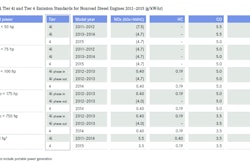
Not that all regulations have been delayed. Two important mandates have been passed within the past year – the new low-sulfur diesel fuel requirements for off-highway equipment and the interim Tier 4 requirements for off-highway engines between 175 and 750 hp implemented in January.
The Tier 4 standards call for the most significant reduction in off-highway regulations since the first standards were passed 15 years ago. When fully implemented in 2015, particulate and NOx emissions will have been reduced to virtually zero. The new Tier 4 equipment is expected to hit some headwinds when it shows up on dealer floors this year due to its higher cost, the slow economy and end-user anxiety over the new technologies manufacturers employed to meet the standards, including exhaust gas recirculation (EGR) and selective catalytic reduction (SCR). There are also some concerns about the use and availability of the new ultra-low sulfur fuel needed to make the technology work.
Regulatory scandals
The most significant setback for regulators occurred in California, where the state delayed implementation of its in-use exhaust emission standards for bulldozers, dump trucks, forklifts, cranes and other off-highway equipment. That occurred after the California Air Resources Board (CARB), was forced to concede major flaws in two of the calculations it used to justify the regulation.
The state agency had to back off claims that off-highway diesel soot was responsible for 18,000 deaths in California per year. It revised the number to 9,200, after it was revealed that the scientist who oversaw the study had forged his professional credentials.
Shortly thereafter, the state was forced to back off its estimate of NOx emissions, which were based on the amount of fuel consumed by off-highway vehicles. It reduced its estimate from 1 billion gallons to 228 million gallons per year after the initial calculation was challenged by independent researchers. With the 77-percent reduction in the fuel consumption estimates and 50-percent reduction in the mortality rate, off-highway equipment looked much less threatening to both humans and the environment.
Despite the dramatic changes, regulators didn’t scrap the rules. Instead, they delayed implementation by four years, which means the regulations won’t impact most users until at least 2019. Whether additional delays will be implemented remains unclear, but there’s no doubt CARB’s missteps have damaged its credibility and made it more difficult for the state agency to aggressively pursue regulations. That’s significant, because California’s regulations are often replicated by other states and the federal government. For example, before the scandals, some 20 states were seriously considering implementing their own in-use regulations based on the California model.
Cap-and-trade grinds to a halt
A similar scientific scandal at the global level helped to stall the regulatory train in Washington. “Climate-gate” revealed that prominent researchers behind much of the global warming research had colluded to suppress data that contradicted their theories and scientific models. Like the California scandal, it raised questions as to how much of the science was based on fact and how much was rooted in environmental politics. The climate-gate scandal, coupled with Republican victories in November, stalled congressional action and has made it more difficult for the federal Environmental Protection Agency to move forward with its own regulations.
Not all government initiatives have come to a halt, however. The EPA is proceeding with its plan to tighten ground-level ozone standards, which were last modified in 2008. The proposed standards are currently being reviewed by a scientific review panel. If they clear the panel, the EPA is expected to take final action this summer, which could increase the number of designated non-attainment areas from 300 to 500. That’s significant, because the non-attainment designation triggers additional regulations and requirements designed to bring non-attainment areas into compliance.
Federal, state and local governments also maintain considerable leverage to reduce emissions from off-highway equipment. An increasing number of government agencies require that contractors working on roads and other public projects certify that their equipment meets low-emission standards.
A different relationship with end-users?
The changes that have occurred in the last few years may delay, but won’t end, the advance of off-highway emission regulations. As the EPA’s non-attainment designation process has demonstrated, increasingly tighter standards will be pursued as technology allows for the measurement of increasingly miniscule particles. Regulators will face a more skeptical audience when making their case, but that does not mean they won’t stop trying.
Given that change is likely to be the only constant in the emissions world, manufacturers and dealers are looking to strengthen their relationships with end-users.
The high cost of diagnostic equipment and technician training may prompt fleet owners to change the way they approach maintenance, turning more of these tasks over to dealers. In addition, the new low-sulfur fuel will require more additives to make up for a loss of lubricity. Some equipment manufacturers and dealers are helping contractors and fleet owners keep abreast of regulatory changes, especially those that will impact their ability to secure government jobs.
Without question, the events of the last two years have changed the trajectory of off-highway emissions. The result may be a more reasoned and informed approach to maintaining and improving the environment with solutions that don’t strangle economic growth.