In this interview, Doug LeRoy, Global Market Manager at LORD, discusses how advances in the technologies used in steer-by-wire (SbW) systems are fueling the adoption and growth of electric steering systems.
Please explain the differences and advantages of steer-by-wire (SbW) systems over conventional mechanical steering control systems.
Electric steering systems simplify vehicle assembly and replace traditional vehicle parts such as steering columns, shafts, pumps, hoses, belts and coolers. They offer more precise brake and steering control. However, simply incorporating electric steering does not ensure a robust steering solution that provides the smoothness and control fidelity needed for precise, safe vehicle operation. LORD Corporation, as a supplier of magnetically responsive (MR) tactile feedback devices (TFD®) for use in steer-by-wire systems, has pioneered several solutions that enable robust SbW systems.
As SbW systems become more popular, which markets are adapting these systems into their vehicles and why?
Steer-by-wire (SbW) systems are becoming increasingly prevalent in the industrial vehicle market, especially for material handling vehicles, and more recently, agricultural and construction trucks. Currently, the industrial lift truck market is one of the major users of electric steering systems. The need to increase productivity, optimize energy usage, and enhance operator ergonomics in the areas of safety and comfort, makes SbW systems very appealing to lift truck manufacturers.
How have LORD Corporation’s magnetically responsive (MR) tactile feedback devices (TFD®) changed the face of electric steering systems?
Electric steering systems require an input device – such as a LORD TFD® Steer-By-Wire brake. Advances in sensing technology have allowed LORD TFDs to provide more precise driver control while offering cost-savings to vehicle manufacturers.
Pure electric steering systems do not necessarily offer steering “feedback” to the driver since the steered wheels are isolated from the operator. As a result, operators may not have a sense of control over the steering wheel – something they are used to experiencing with hydraulic or mechanical steering.
If a steering wheel is connected to a sensor without any variable feedback resistance, the steering wheel might spin out of control if the driver hits a bump or the vehicle could be difficult to control precisely. A LORD TFD provides controllable torque to stabilize the steering wheel, enabling the operator to be in better control of the vehicle.
Making the vehicles more comfortable and safe for the driver is of prime importance to industrial vehicle manufacturers. How does LORD Corporation’s MR-enabled TFDs help to enhance the operator’s driving experience?
MR-enabled TFDs provide two main functions in a vehicle system - the first is to provide a sensor that measures how far an operator wants to turn the steering wheel. The sensor communicates the steering wheel position to the vehicle, telling it how much to turn. Second, the TFD provides tactical feedback to the driver – a control torque response – that gives the operator a feeling of “connectedness” to the vehicle.
LORD Corporation’s strong electro-mechanical development background has made it a leader in choosing the best sensor for an application. We are very familiar with sensors and safety levels, and offer multiple levels of safety and redundancy in the sensor system.
With a LORD TFD® Steer-By-Wire brake and electric steering, a warehouse truck operator can navigate more accurately through narrow aisles and safely turn corners faster. The combination of more precise driver control and safety leads to increased productivity, a cost-saving advantage for any industrial business.
It’s really about more than just making the operator feel good when driving. If the operator feels more in control of the vehicle, he will operate the equipment with more confidence. Ultimately, this leads to more productivity.
What benefits does LORD Corporation’s MR brake technology offer over other brake systems?
MR brake technology has a unique method of generating torque. It uses iron-particle materials to generate torque over a full range of velocities and speeds, resulting in very precise torque control with extremely smooth transition from one torque level to another. Response time, measured in milliseconds, provides fast and accurate control.
An MR-enabled LORD TFD® Steer-By-Wire brake eliminates many of the typical problems encountered when using other technologies such as friction brakes - stick-slip, lack of smooth torque response, and/or actuation noise. In addition, since it is a magnetic technology, the torque is independent of operating temperature. This offers many advantages, especially in various ambient temperature areas such as a cold-storage warehouse, or a hot, humid factory or outdoor environment.
The high degree of fidelity in brake control offered by LORD Corporation’s MR technology is almost impossible to replicate in a friction brake application. This very fine control of torque with extremely smooth transition from one speed level to another is very attractive to vehicle manufacturers. That this torque can be generated with very little power is another major advantage.
For the operator, MR technology provides a smooth feel. There is a strong operator preference over friction brake technology when it comes to quality of feel in TFD® steering devices.
How does an industrial vehicle manufacturer incorporate a TFD system into its equipment?
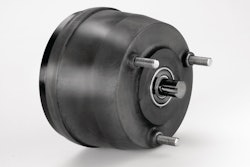
A LORD TFD is furnished as a complete unit – a single electro-mechanical assembly. Sensors, brakes, connections, couplings, bearings and shafts are built into one, integrated steering unit that is available ready-to-use. To install it, the customer just has to attach the TFD to the vehicle dashboard, add a steering wheel and plug the unit into a controller – a steering column is not needed – the TFD is the steering column.
How can electronic steering systems benefit other vehicle markets such as the agricultural and construction industries?
In both the agricultural and construction vehicle markets, steer-by-wire systems offer productivity improvements for farming and paving.
The adoption of electronic steering along with Global Positioning Systems (GPS) is the real impetus for SbW systems in the agricultural industry. Farming is all productivity driven and electric steering allows the farmer to operate a tractor with extreme efficiency and control. With a TFD input device, you can command the electronic steering system in a similar way to how the GPS commands the steering system.
As the tractor moves along a farming row, it is actually steered by the GPS signal – the ultimate cruise control. However, at the end of a row, due to safety precautions, the tractor cannot turn itself based on the GPS signal. In the previous generation of tractors, the steering would switch to standard hydraulic steering to make a turn. Now, with a TFD input device, you are eliminating the redundant steering system.
Using GPS to steer a tractor frees up the farmer to concentrate on other aspects of farming. The GPS not only steers the vehicle, but also determines the rate of fertilizer and seed use. A farmer can monitor this activity “down to the meter” for decisive cost control.
Similar electric steering advancements are taking place in the construction industry, where needs are comparable to the agricultural industry. Paving trucks are good examples of how electric steering has been adopted in the construction market. These trucks require two or three steering points for safe operation, necessitating steering on both sides of the vehicle and this is very complex to achieve with hydraulic steering. Electric steering systems enable quick change of the operator station based on operating condition requirements.
With a steer-by-wire system and a TFD device, an operator can set-up a paving truck in a particular direction, and then focus on adjusting the load and road pavement activity. Once the steering is set-up and stabilized, it frees the operator to do other things in addition to controlling the direction the vehicle is moving.
Will SbW systems eventually be adapted for the average road vehicle?
In the future, the average car driver may benefit from steer-by-wire systems, too. While it is acknowledged that broad use of by-wire steering in highway vehicles may be years away from public acceptance, the trend is clear in the industrial vehicle market. As the advantages of SbW become more popular for industrial vehicle, it will become clear that steer-by-wire can be beneficial for commercial vehicles, too. Increasing requirements for ergonomic features within industrial vehicles and sophisticated buyers in developed countries will keep innovation moving.