*This article is sponsored by Napoleon Engineering Services
It was a frigid morning in Olean, New York, when a customer called Napoleon Engineering Services (NES) with a question.
“Can you test a new batch of bearings for us?” the individual asked.
NES had previously worked with this company, which manufactures, among other things, seed planters. Consequently, it was keenly aware of this application’s bearing failure mode: environmental contamination. And because it understood this — and, by extension, the customer’s objective — NES could tailor a testing program to fit those needs.
“[We needed] to evaluate the seal efficiency under a moment load because that’s exactly what’s happening in that (planter’s) disc,” said Chris Napoleon, NES’ president and chief engineer. “It’s in the dirt and the life of that disc is directly related to the efficiency of that seal.”
“So,” Napoleon added, “we ran a mud slurry test.”
NES routinely receives similar inquiries from an array of industrial and off-highway vehicle companies — “Can you test these bearing for us?” And that stands to reason; NES, after all, began as a bearing testing company and, nearly 30 years later, has come to boast the largest independent bearing testing and inspection facility in North America.
To create that personalized — and proper — testing program, however, NES needs to know:
What are the customer’s testing intentions?
What is it truly attempting to accomplish?
Or more to the point, “What is the failure mode inside that application, which will then allow us to pinpoint what we’re going to do?” Napoleon asked.
Bearings, of course, fail for several reasons.
The least likely failure mode, in NES’ experience, is spalling, a progressive fatigue failure where small, flaky pits break away from a bearing’s raceway or rolling elements. “But almost every application fails for some other reason before it can reach this point,” said Tom Jaskolka, NES’ senior testing engineer.
The most likely of those other causes is improper or insufficient lubrication.
According to studies, lubrication issues account for approximately 50% to 80% of all premature bearing failures. Said Jaskolka, “Ideally, when you’re running a bearing, the lubricant inside should provide separation between all the metal components, so you shouldn’t get metal-to-metal contact. Breakdown of that lubricant is usually one of the bigger failure modes.”
Lubrication (grease being the most common) might degrade due to high temperatures or contamination. When this happens, and rolling elements begin contacting the raceway unprotected, the resulting friction will deteriorate the bearing’s surface. “So, this is categorized as a ‘wear failure,’” Jaskolka said.
It’s within these realms that NES can implement its testing expertise.
The Western New York-based company offers several tried-and-true Standard Bearing Testing (SBT) programs, including endurance/life, rolling contact fatigue, wear, environmental and impact or static load. Its goal is to match the appropriate testing program with a customer’s needs.
To understand those needs, however, it must know: What’s the failure mode?
“What kind of test are we going to run to help reduce risk in the application?” Napoleon asked. “We need to identify what the failure mode is so that we can understand the testing intentions and design a test plan that meets those intentions.”
Once NES understands the purpose, the pathways to testing become clear.
And inside its 15,000-square-foot testing facility, there are several.
Say, for example, one wants to determine how different greases may impact bearing life while running at a high temperature. Napoleon Engineering will create the applicable testing plan using its Standard Bearing Testing.
“We have rigs that we’ve developed — we test deep-groove ball bearings at high temperature, and it’s really a grease test,” Napoleon said. “We’re using bearings to figure out how well a grease will perform at high temperatures. How long will it let that bearing run before the grease lubricating properties deteriorate and influence bearing life?”
Customers, especially those in need of a wear-related test, will often turn to NES because they’re unable to wait for an application failure. In those scenarios, it might take 10 years to see a bearing failure. NES can create that failure within only hundreds of hours, thereby giving customers the data it needs, in a timelier fashion, to assess bearing performance.
“We’ll do some kind of acceleration to get that failure to happen faster,” Jaskolka noted, “and that acceleration could be speed, load, temperature or environmental (for which NES has created mud slurry and dust box tests).
“Once we drive which type of failure we want to focus on, then we try to fit that into one of our Standard Bearing Tests.”
Typically, customers will ask NES to create an assembly like their own for testing purposes.
NES, however, in the interest of cost and lead times, prefers to remove that bearing from the application entirely and fit it into one of its existing rigs. This not only simplifies the process but allows the company greater control of testing parameters. “There might not be an easy way to apply load to it,” Jaskolka pointed out, “so we’ll take the bearing out and we’ll put it into one of our endurance test rigs.”
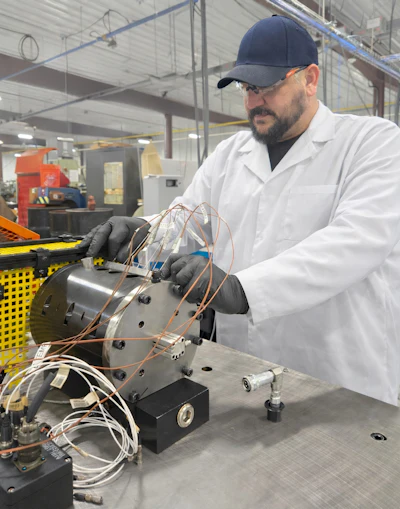
NES features over 100 bearing testing platforms, including dozens of overhung load and four-bearing housings to evaluate wear, endurance and bearing efficiency in test rigs of varying sizes. It can test bearings as small as one inch and as large as 10-12 inches in outside diameter and can accommodate speeds up to 20,000 rpm. Upon conclusion of testing, NES will also provide statistical analysis in its test reports.
“Most customers fit into something that we already have,” Jaskolka said. “We have all these components on the shelf, and we can kind of mix and match what makes sense. The rigs are flexible as far as trying to figure out what works for the customer.”
And this is all done with a specific purpose in mind:
“To drill down to the Standard Bearing Test that meets your intentions,” Napoleon reiterated, “and is related to the potential failure mode within the application so that you have the appropriate technical information to make informed decisions.”