As the world continues to re-evaluate common practices and machine designs with an eye toward greater sustainability, there has been a lot of focus in the off-road market on greener sources of power, whether it be battery-electric or alternative fuels. Complicating the desire to “go green” is the need to balance the impact to the environment with an array of other considerations, such as operational efficiency, overall costs, maintenance needs, downtime and noise.
Biodiesel has emerged as one of those options because of its track record for reducing emissions. Compared to traditional diesel fuel, biodiesel combustion results in lower emissions of particulate matter, carbon monoxide and hydrocarbons. Being made from renewable resources like vegetable oils, animal fats and recycled cooking oil, biodiesel also reduces the industry’s reliance on fossil fuels.
Beyond its obvious environmental benefits, biodiesel offers other advantages, as well, including enhanced engine performance/greater efficiency and potentially lower maintenance costs in the long run. This is because biodiesel has a higher lubricity than petroleum diesel, which can reduce wear on engine components, particularly in the fuel injection system, potentially extending engine life.
As the world continues to re-evaluate common practices and machine designs with an eye toward greater sustainability, there has been a lot of focus in the off-road market on greener sources of power, whether it be battery-electric or alternative fuels. Complicating the desire to “go green” is the need to balance the impact to the environment with an array of other considerations, such as operational efficiency, overall costs, maintenance needs, downtime and noise.
The Advantages of Biodiesel
Biodiesel has emerged as one of those options because of its track record for reducing emissions. Compared to traditional diesel fuel, biodiesel combustion results in lower emissions of particulate matter, carbon monoxide and hydrocarbons. Being made from renewable resources like vegetable oils, animal fats and recycled cooking oil, biodiesel also reduces the industry’s reliance on fossil fuels.
Beyond its obvious environmental benefits, biodiesel offers other advantages, as well, including enhanced engine performance/greater efficiency and potentially lower maintenance costs in the long run. This is because biodiesel has a higher lubricity than petroleum diesel, which can reduce wear on engine components, particularly in the fuel injection system, potentially extending engine life.
Biodiesel is additionally attractive because of its compatibility with current systems. Most diesel engines can run on biodiesel blends up to B20 (20% biodiesel) with no or minimal modifications. Although biodiesel is slightly more expensive than traditional diesel fuel, it more than makes up for the added costs by increasing efficiency, extending service time, and reducing maintenance requirements.
Not All Biodiesel Blends Are the Same
When discussing biodiesel, it is more accurate to refer to it as a biodiesel blend. B100, which is the purest of all biodiesels, is the only form on the market that is 100% biodiesel. It is not often used in off-road vehicles, however, because it is unreliable in colder temperatures and requires more engine modifications before it can be used.
The majority of biodiesels most frequently used on the market today are biodiesel blends, meaning they are part biodiesel and part petroleum diesel. The number in their name refers to the percentage of biodiesel that is in the blend. So B5, for example, refers to a blend that contains 5% biodiesel. It is one of the more common biodiesel blends on the market because it requires no engine modifications. The higher the percentage of biodiesel in the fuel, the greater the emissions reduction. B20 is an example of a biodiesel blend that offers a good balance of low emissions and reliable cold-weather performance. When using a B20 fuel, it is realistic to expect a roughly 22% reduction in particulate matter.
One concern about using biodiesel for fuel is that it takes away from the food (primarily corn) that is used to feed people and animals. At the rate that biodiesel is currently being used in the industry, there are no concerns about it hurting food security. However, it is a long-term consideration should biodiesel ever become a more commonly used fuel and then aggressively compete with food production around the globe.
That’s why interest has been growing in newer forms of biodiesels that don’t require corn. Algae-based biodiesels, for example, are renewable fuels derived from algae that offer a lot of advantages, including:
- Their high oil content makes them efficient for heating.
- They have low-land requirements, so they do not take away from land being reserved for food production.
- Algae grows rapidly — faster than traditional crops — so it provides a readily abundant option.
- It absorbs carbon dioxide to effectively reduce greenhouse gas emissions.
- Finally, algae can recycle nutrients.
While algae-based biodiesel offers a lot of promise as a future sustainable fuel source, it is not yet widely used in mainstream industries due to high production costs. Pilot projects are up and running, but the technology hasn’t yet reached a point of economic competitiveness with fossil fuels or other biofuels.
Challenges Remain
Despite the many benefits afforded by biodiesel in any form, it is not without its limitations and concerns. Many challenges remain. The magnitude of those challenges varies by application and industry, but some of the more common include:
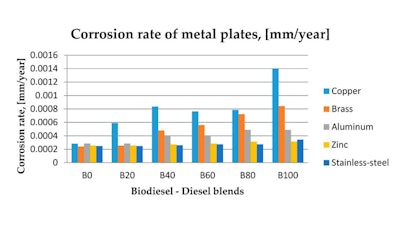
- Material compatibility — Biofuels can be more corrosive, creating a need for additives to protect vulnerable metal components. The level of corrosiveness depends on the percentage of biodiesel in the blend, with B100 being the most corrosive. Of the various metals used in off-road vehicles, copper is the most affected by changes in blends, whereas zinc and stainless steel are the least affected.
- Temperature sensitivity — Due to the viscosity of biodiesel, its performance varies widely depending on the percentage of biofuel used in the blend. Again, the more biofuel, the greater the problems during cold weather.
- Storage and stability — Biodiesel can degrade over time, especially if it’s exposed to moisture or air.
- Regulatory compliance — Currently, the rules for creating, using, storing and disposing of biodiesel vary by region, state and country.
- Performance variation — In addition to temperature variations, the quality and performance of the blend depends on the quality of the feedstock.
- Filtration concerns — Filters may require more maintenance in vehicles powered by biodiesel because of its unique composition, solvent properties and a potential for contamination. The higher the percentage of biodiesel in the blend, the greater the risk of filters clogging.
- Lack of infrastructure — Demand for biodiesel will be limited until the necessary infrastructure is in place, such as sufficient biodiesel refueling stations.
- Lack of awareness and funding — It will likely take government incentives and lots of R&D to increase awareness for biodiesel as an option and make it economically viable.
Considerations When Specifying Components
Whenever a different fuel is used, there are material compatibility considerations to address. The same is true if switching to biodiesel. Every component within the system, down to the smallest fitting, needs to be evaluated to ensure its material can tolerate biodiesel. This is when it’s especially important to work with your supplier or suppliers to understand the limitations of the material you’ve chosen. As mentioned previously, biodiesel is much more corrosive than straight diesel fluid. Other compatibility considerations include thermal stability, durability and longevity, safety and reliability, environmental and regulatory compliance, performance optimization and cost effectiveness.
Key considerations include temperature resistance, pressure rating, sealing integrity, surface finish, and installation practices, to name a few.
 Parker’s STAMPED specifying process is used for comprehensive evaluation of components such as fittings and hoses.Parker Hannifin
In order to perform a comprehensive evaluation, Parker suggests using the STAMPED specifying process for all components — from fittings to hoses. STAMPED stands for size, temperature, application, material, pressure, ends, and delivery, as further explained below:
- Size — refers to thread size and the diameter of what you’re connecting to
- Temperature — refers not just to the external temperature but also the temperature of the media. A component that is close to the engine, for example, will likely need to tolerate more heat than a component that is located farther away.
- Application — refers to where the component will be used and what it’s expected to do.
- Material — refers to the type of material that will be in contact with the media and whether or not it is compatible and can tolerate the fluid.
- Pressure — means considering the maximum operating pressure in operation because this affects the type of connection, i.e. compression or bar
- Ends — refers to what type of connection is interfacing with the component
- Delivery — refers to any special requirements, such as certification, that are required when delivering the component
Of all the criteria, material likely requires the most consideration because it’s not just based on compatibility. Other considerations when specifying a particular material include price, connection speed, corrosion resistance, durability, weight, temperature limitations, pressure limitations and configuration (space) limitations.
 Comparison of Composite, Electroless Nickel Brass, and Stainless Steel materials highlights differences in cost, durability, pressure rating and configurability.Parker Hannifin
Common material options include composites, electroless nickel brass and stainless steel. All three resist corrosion, but their other attributes vary. Composites are the least expensive but aren’t as durable because they are lighter in weight. They have the same excellent temperature limits as the other materials but have the lowest pressure rating (although it ultimately depends on the connection). They also have configuration limitations because once the design is locked, you can’t reconfigure.
Stainless steel is the most expensive but also the most reliable. As a metal, it allows you to configure the fittings (same as with all metal options).
Fitting connection types must also be considered. The ultimate decision will depend on the application, the material of the components being specified, and the media. Here are the most common forms:
- Quick connect — Advantages include quick and easy installations because few, if any, tools are required. This results in reduced downtime. They additionally offer a leak-proof design, are versatile, safe and don’t require a lot of space. On the downside, they have limited pressure ratings and compatibility issues. Since they are thermoplastics, you have to handle them with care and not hit them too hard. They are usually part of an off-the-shelf solution, so customization is not an option.
- Compression — These fittings are very robust and create a leak-proof connection. They are easy to install with minimal tool requirements. They are also compatible with many connection types. However, they have a limited temperature range, limited pressure ratings and size limits.
- Barbed (with raised edges) — These fittings are also very reliable in creating a secure connection. They are also easy to install, lightweight, versatile, compatible and widely available. As for disadvantages, they have a limited temperature range and limited pressure rating. Plus, they often require additional maintenance.
Sealing solutions are equally important to consider when using biodiesel so there are no weak links in the chain. Like other components, they must be compatible with biodiesel and able to resist degradation. It’s important to focus on the section that will be exposed to possibly jeopardize the integrity of the seal. A popular option is O-rings, either made of PTFE or FKM. PTFE is a low-friction material that is highly compatible with a large temperature range. FKM O-rings are not low friction.
Materials like nitrile rubber or polyurethane, natural rubber, or neoprene can’t be used because these are likely to break down with biodiesel. Of course, there is a way to overcome many compatibility concerns with various plating options that can significantly improve a material’s durability at a much lower cost than specifying stainless steel.
Zinc and zinc nickel are common plating options today, although zinc nickel does a better job of creating a robust protective layer while zinc tends to oxidize quickly, resulting in fuel contamination. A newer option that provides superior protection is electroless nickel plating which uses a nickel phosphorus alloy. Through a chemical immersion process, this option provides a uniform coating on the inside and outside, even when coating an odd-shaped fitting.
Conclusion
Biodiesel is increasing in popularity around the world and being used in multiple industries. It offers major advantages for off-road vehicles, especially in the area of sustainability. Before making the switch, however, there are many things to consider, particularly relative to component material compatibility.
Choosing the right components is critical because biodiesel has a limited shelf life and is very corrosive. Several leading manufacturers suggest the STAMPED process for choosing components and fittings. If a particular material doesn’t fit within your budget parameters, you could consider plating to get the protective advantages of stainless steel at a lower cost.