Despite a complex global environment marked by high interest rates and evolving tariffs, experts suggest the outlook for the off-highway equipment market remains cautiously optimistic. As reported, fundamental demand drivers in construction and agriculture are strong, but manufacturers must navigate significant geopolitical and technological shifts to succeed.
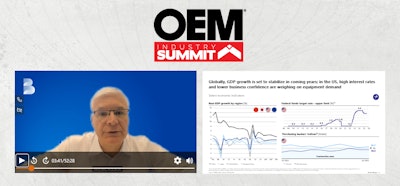
According to the executive outlook session, presented by Dr. Wilfried Aulbur of Roland Berger as part of the Fall 2025 OEM Industry Summit, the global economy has performed better than many feared. Global GDP growth is projected to be around 2.8% in 2025, with the U.S. economy holding up well at approximately 2% growth. However, this stability is challenged by a rapidly changing regulatory environment and trade policies that create uncertainty. Aulbur noted that recent U.S. tariffs are at levels not seen since World War II, with the majority of the costs (51%) sustained by U.S. businesses. For OEMs, according to Aulbur, the conditions of environment put a premium on agility, scenario planning and strategic partnerships. Read on for a recap of this session's priority points.
Construction Growth Continues Despite Headwinds
The global construction market is poised for continued growth, driven by fundamental needs for housing, infrastructure and commercial buildings. Projections show the U.S. market growing at 4% to become a $3.7 trillion market by 2030. Europe is expected to see 5% growth to reach a $5 trillion market, while the Asia-Pacific (APAC) region leads with 6% growth, becoming a $10 trillion market by 2030.
Equipment sales volumes are growing at about 3%, with a notable shift toward more versatile and capable compact equipment. The value growth in the compact segment is even higher, reflecting a product mix shift toward higher-margin machines like compact track loaders. However, volatility from steel tariffs could create a more subdued market in 2025, with a potential rebound in 2026 as price increases are absorbed by the market.
Key challenges facing the industry include persistent labor shortages and increasing competition from Chinese OEMs. With their domestic market collapsing, Chinese manufacturers like Sany and XCMG are aggressively pursuing global market share in Latin America, Africa, Southeast Asia and even Europe. While their products are considered adequate for these emerging markets, they add significant competitive pressure.
Agriculture Seeks Stability and Tech-Driven Efficiency
The agricultural equipment market shows more modest growth, projected at about 1.5%. The market is twofold: sales of large machinery like combines and high-horsepower tractors are driven by net farm income, while small equipment sales are more closely tied to general GDP growth.
Net farm income has been under pressure, creating a challenging environment. However, government support for farmers is expected to exceed $40 billion in 2025, which could provide a needed boost and translate into equipment purchases.
The most significant trend in agriculture is the rapid adoption of precision farming. OEMs are increasingly shifting to become technology companies, with software, sensors and robotics becoming major drivers of farm efficiency. This includes the expansion of aftermarket and retrofit markets for precision technology and the emergence of smaller, specialized autonomous machines for tasks like weeding and seeding.
Technology and Trade Reshaping the Landscape
Across both construction and agriculture, several overarching trends are reshaping the competitive environment. The push for automation and autonomy is a direct response to labor shortages. Operator-assist features like grade control and collision avoidance are becoming common, allowing less-qualified operators to be productive and shortening the "time to talent." While full autonomy is the ultimate goal, these intermediate steps are already delivering value.
Electrification, meanwhile, is expected to have limited overall penetration in the construction and agricultural sectors. Its adoption will be concentrated in specific use cases where it makes clear financial sense, such as compact equipment in urban areas or in regions with very low electricity costs.
Ultimately, the off-highway industry is operating in an era where political and regulatory decisions are the primary drivers of business strategy. The global trade landscape is fracturing, forcing companies to diversify supply chains and reevaluate market priorities. Success in this environment will belong to companies that can remain agile, make informed decisions amidst uncertainty and invest strategically in the technologies that address the industry's most pressing challenges.