Remember when GPS was little more than a dot on a map? In the early days of telematics, heavy equipment owners and fleet managers primarily used location data to see whether a machine was running, where it was parked or if it had been stolen.
Today, this technology can do so much more. Now, GPS — or more accurately, GNSS (global navigation satellite system) — is the starting point for almost every type of task automation. By combining high-accuracy location data with internal sensors and electro-hydraulic valves, these systems move from simply showing information to actively controlling machine movements.
To see how this integration is changing the way we build and operate machines, let’s look at two specific examples: excavators and compactors.
The Shift to Automated Excavator Hydraulics
Historically, achieving a perfect grade with an excavator relied on the operator’s eye, physical stringlines and grade checkers in the trench. When 2D and 3D machine control first hit the market, it was a massive leap forward. Volvo Construction Equipment
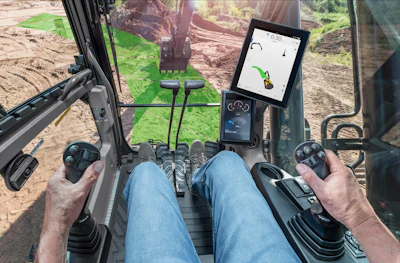
Grade assistance systems in the early days used GNSS antennas on the rear of the machine and precision sensors on the boom, arm and bucket to calculate the exact position of the cutting edge. This gave the operator a digital stringline on an in-cab display. It was incredibly helpful, but it was still just an assistive feature. The operator had to manually manipulate the joysticks to match the 3D model on the screen.
The true breakthrough for OEMs came with the move to electro-hydraulic (EH) control systems. While aftermarket automation has existed for years by tapping into traditional pilot lines, the shift to a digital steer-by-wire architecture changed everything. When the physical pilot lines and manifolds are removed, the machine’s software can communicate directly with the main control valve. This streamlined architecture allows for a much more responsive and integrated system, executing movements with a level of speed and precision that manual or even older add-on automated platforms just couldn’t reach.
For automated grading functions today, the architecture is fundamentally different. The machine processes the 3D model against the centimeter-level RTK (real-time kinematic) GPS position to constantly calculate the required bucket trajectory.
This means that when the operator pulls back on the joystick, they initiate a digital request. The onboard computer receives the signal and dictates the exact oil flow needed for the boom and bucket cylinders. This allows the system to automatically adjust the attachment angle to follow the target grade. The operator simply controls the speed, while the GPS and sensors handle the precision.
By integrating location data with the hydraulic valves, you eliminate over-digging, reduce the need for rework and allow operators of all experience levels to achieve near-perfect grades. It’s a great example of how a component once used for tracking can now execute physical work.
How GPS Improves Compaction Quality
Excavator automation is fairly easy to understand and appreciate, but the role of GPS in compaction may be even more valuable because it solves a critical visibility problem. When you’re rolling soil or asphalt, you can’t actually see the density of the material you’re working on. Volvo Construction Equipment
Compaction is a balancing act. Under-compacting leads to premature material failure, while over-compacting crushes the aggregate, compromises structural integrity and wastes fuel. Typically, operators rely on counting passes in their heads, visually identifying the edges of their previous passes and trusting their instincts and experience to know when surfaces are at the desired compaction level.
Today, intelligent compaction incorporates GNSS, precision accelerometers and in-cab displays. On a soil compactor, the sensors measure the vibration and rebound of the drum to determine the material’s relative stiffness. But a stiffness reading or compaction measurement value (CMV) is only useful if you know exactly where that measurement was taken.
This is why GPS integration has become vital. The GNSS receiver anchors every data point to a specific geographic coordinate. As the machine rolls, the operator’s display paints a color-coded map of the site. They see where they’ve driven, and a heat map shows pass counts and material stiffness.
For asphalt compactors, this goes a step further with infrared temperature sensors mounted on each end of the machine. Because asphalt can only be effectively compacted within a specific temperature range, systems also map temperature data alongside the pass counts. The operator can easily see if a stretch of mat is cooling too quickly and prioritize rolling that section before it’s too late.
By utilizing GNSS to map sensor data in real time, intelligent compaction systems remove the guesswork.
The Foundation for Autonomy
We’ve reached a point where the distinction between the mechanical and digital behaviors of a machine has mostly disappeared. By pulling GNSS data directly into the machine’s logic, location tracking becomes a crucial function that dictates how the machine actually moves and performs.
Connecting satellite data with sensors and hydraulics does more than just simplify an operator’s day. It creates a closed-loop system where the machine knows exactly where it is and how it’s performing at every moment. That level of precision is the baseline we need if we’re ever going to reach full autonomy.
We’ve moved far beyond tracking machines on a map; we’re now using that location data as a core part of the machine’s operation, and that’s a shift that will only accelerate from here.