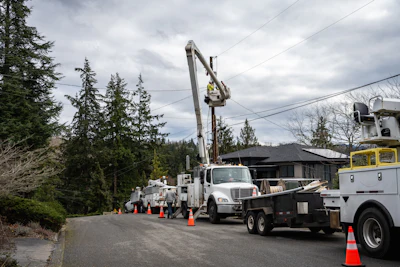
Specialty truck manufacturers operate in one of the most operationally complex segments of industrial manufacturing. Unlike traditional automotive production, where high volumes and standardized platforms dominate, the specialty truck sector is built around configure-to-order (CTO) models. Refuse trucks, utility vehicles, fire apparatus and other vocational platforms often incorporate hundreds of component variations tailored to specific fleet requirements.
Demand for these vehicles remains strong. According to NTEA – The Work Truck Association, the vocational truck market continues to be supported by infrastructure investment, municipal fleet replacement cycles and expanding service industries that rely on specialized equipment.
A Traditionally Conservative Industry Meets Modern Supply Chain Volatility
The specialty truck manufacturing sector has long been defined by engineering expertise, craftsmanship and deep operational experience. Compared with industries such as high-volume automotive or electronics manufacturing, however, it has historically been slower to adopt advanced digital technologies.
Many organizations still manage planning through a combination of legacy enterprise systems, spreadsheets and institutional knowledge accumulated over years of operational experience. These approaches have supported decades of growth and product reliability, but they are increasingly difficult to sustain as supply chains grow more complex and volatile.
External pressures have only intensified the challenge. Tariffs, geopolitical uncertainty and supplier disruptions have introduced new layers of risk into an already complex operating environment. Research from organizations such as the Institute for Supply Management continues to highlight supplier lead-time instability and material availability as ongoing concerns for manufacturers across multiple industrial sectors.
For specialty truck manufacturers operating in CTO environments, these disruptions can ripple through production schedules for months.
When Planning Tools Lag Behind Operational Reality
Planning complexity in CTO manufacturing extends well beyond traditional forecasting. Production schedules must accommodate unique configurations, specialized components often require extended lead times, and customer demand can shift rapidly as fleet operators adjust to market conditions.
In many organizations, however, planning tools have not evolved at the same pace as operational complexity.
Reliance on spreadsheets and disconnected systems frequently leads to poor visibility into supply constraints, inconsistent planning data across functions, mismatched inventory levels, and planning cycles that remain largely reactive.
Long-lead components such as chassis, hydraulic systems and specialized assemblies often must be ordered months in advance. Without a clear, integrated view of demand signals and supply constraints, organizations frequently adopt conservative ordering strategies that tie up working capital at a time when inventory management has become an increasingly important financial lever for manufacturers.
The Rise of Connected, Scenario-Driven Planning
A growing number of manufacturers are beginning to rethink planning as a digitally connected enterprise capability rather than a collection of departmental processes.
In this model, operational data from across the organization — including enterprise resource planning (ERP) systems, engineering configurations, supplier commitments, customer orders and inventory signals — is unified into a shared planning environment. This integrated view enables cross-functional teams to work from the same set of assumptions when evaluating operational decisions.
More importantly, connected planning environments allow organizations to simulate the operational consequences of decisions before they are executed.
Manufacturers gain the ability to:
- Identify production and supplier constraints in near real time
- Evaluate alternative sourcing or production scenarios
- Understand the financial and working-capital impact of planning decisions
- Align demand signals with supply capabilities over longer planning horizons
For CTO manufacturers, where every order can represent a unique configuration, this capability can transform planning from a reactive exercise into a strategic advantage.
For example, a specialty truck manufacturer's fragmented data limited production visibility to just a few days, leading to misaligned inventory and supply shortages.
By integrating operational data into a unified planning environment with constraint-based modeling and scenario analysis, the company expanded its clear-to-build roadmap to over a year. Real-time demand signals enabled faster supply adjustments, pulling or pushing orders based on live constraints.
Within a few planning cycles, the company reduced working capital in open purchase orders, cut shop-floor disruptions and improved responsiveness to customer demand.
From Reactive Operations to Predictive Supply Chains
The specialty truck manufacturing sector has always thrived on engineering innovation and the ability to deliver highly customized equipment to demanding customers. But as supply chains grow more interconnected and uncertainty becomes a constant factor, planning capabilities are emerging as an equally important differentiator.
Organizations investing in digitally connected planning are shifting from reacting to disruptions to anticipating them. As a result, digital planning capabilities are becoming a strategic priority. Research from McKinsey & Company suggests that companies adopting advanced planning systems (APS) can significantly improve service levels, inventory efficiency and decision-making speed.
In an increasingly volatile supply chain environment, the ability to align data, evaluate scenarios, and make faster, more informed decisions may ultimately determine which manufacturers lead the next phase of growth in the specialty truck industry.