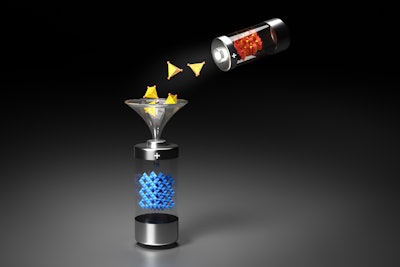
For the past decade, disordered rock salt has been studied as a potential breakthrough cathode material for use in lithium-ion batteries and a key to creating low-cost, high-energy storage for everything from cell phones to electric vehicles to renewable energy storage.
An MIT study is making sure the material fulfills that promise.
Led by Ju Li, the Tokyo Electric Power Company Professor in Nuclear Engineering and professor of materials science and engineering, a team of researchers describe a new class of partially disordered rock salt cathode, integrated with polyanions — dubbed disordered rock salt-polyanionic spinel (DRXPS) — that delivers high energy density at high voltages with significantly improved cycling stability. With optimized compositions, more scalable synthesis methods, better morphology that allows for uniform coatings, lower carbon content, and thicker electrodes, he said, the DRXPS cathode family is very promising in applications of electric vehicles (EVs) and grid storage.
“There is typically a trade-off in cathode materials between energy density and cycling stability … and with this work we aim to push the envelope by designing new cathode chemistries,” said Yimeng Huang, a postdoc in the Department of Nuclear Science and Engineering and first author of a paper describing the work published in Nature Energy. “(This) material family has high energy density and good cycling stability because it integrates two major types of cathode materials, rock salt and polyanionic olivine, so it has the benefits of both.”
Importantly, Li adds, the new material family is primarily composed of manganese, an earth-abundant element that is significantly less expensive than elements like nickel and cobalt, which are typically used in cathodes today.
“Manganese is at least five times less expensive than nickel, and about 30 times less expensive than cobalt,” Li sid. “Manganese is also the one of the keys to achieving higher energy densities, so having that material be much more earth-abundant is a tremendous advantage.”
A possible path to renewable energy infrastructure
That advantage will be particularly critical, Li and his co-authors wrote, as the world looks to build the renewable energy infrastructure needed for a low- or no-carbon future.
Batteries are a particularly important part of that picture, not only for their potential to decarbonize transportation with electric cars, buses, and trucks, but also because they will be essential to addressing the intermittency issues of wind and solar power by storing excess energy, then feeding it back into the grid at night or on calm days, when renewable generation drops.
Given the high cost and relative rarity of materials like cobalt and nickel, they wrote, efforts to rapidly scale up electric storage capacity would likely lead to extreme cost spikes and potentially significant materials shortages.
“If we want to have true electrification of energy generation, transportation, and more, we need earth-abundant batteries to store intermittent photovoltaic and wind power,” Li said. “I think this is one of the steps toward that dream.”
That sentiment was shared by Gerbrand Ceder, the Samsung Distinguished Chair in Nanoscience and Nanotechnology Research and a professor of materials science and engineering at the University of California at Berkeley.
“Lithium-ion batteries are a critical part of the clean energy transition,” Ceder said. “Their continued growth and price decrease depends on the development of inexpensive, high-performance cathode materials made from earth-abundant materials, as presented in this work.”
Overcoming obstacles in existing materials
The new study addresses one of the major challenges facing disordered rock salt cathodes — oxygen mobility.
While the materials have long been recognized for offering very high capacity — as much as 350 milliampere-hour per gram — as compared to traditional cathode materials, which typically have capacities of between 190 and 200 milliampere-hour per gram, it is not very stable.
The high capacity is contributed partially by oxygen redox, which is activated when the cathode is charged to high voltages. But when that happens, oxygen becomes mobile, leading to reactions with the electrolyte and degradation of the material, eventually leaving it effectively useless after prolonged cycling.
To overcome those challenges, Huang added another element — phosphorus — that essentially acts like a glue, holding the oxygen in place to mitigate degradation.
“The main innovation here, and the theory behind the design, is that Yimeng added just the right amount of phosphorus, formed so-called polyanions with its neighboring oxygen atoms, into a cation-deficient rock salt structure that can pin them down,” Li explains. “That allows us to basically stop the percolating oxygen transport due to strong covalent bonding between phosphorus and oxygen … meaning we can both utilize the oxygen-contributed capacity, but also have good stability as well.”
That ability to charge batteries to higher voltages, Li said, is crucial because it allows for simpler systems to manage the energy they store.
“You can say the quality of the energy is higher,” he said. “The higher the voltage per cell, then the less you need to connect them in series in the battery pack, and the simpler the battery management system.”
Pointing the way to future studies
While the cathode material described in the study could have a transformative impact on lithium-ion battery technology, there are still several avenues for study going forward.
Among the areas for future study, Huang said, are efforts to explore new ways to fabricate the material, particularly for morphology and scalability considerations.
“Right now, we are using high-energy ball milling for mechanochemical synthesis, and … the resulting morphology is non-uniform and has small average particle size (about 150 nm). This method is also not quite scalable,” he said. “We are trying to achieve a more uniform morphology with larger particle sizes using some alternate synthesis methods, which would allow us to increase the volumetric energy density of the material and may allow us to explore some coating methods … which could further improve the battery performance. The future methods, of course, should be industrially scalable.”
In addition, he said, the disordered rock salt material by itself is not a particularly good conductor, so significant amounts of carbon — as much as 20 weight percent of the cathode paste — were added to boost its conductivity. If the team can reduce the carbon content in the electrode without sacrificing performance, there will be higher active material content in a battery, leading to an increased practical energy density.
“In this paper, we just used Super P, a typical conductive carbon consisting of nanospheres, but they’re not very efficient,” Huang said. “We are now exploring using carbon nanotubes, which could reduce the carbon content to just 1 or 2 weight percent, which could allow us to dramatically increase the amount of the active cathode material.”
Aside from decreasing carbon content, making thick electrodes, he adds, is yet another way to increase the practical energy density of the battery. This is another area of research that the team is working on.
“This is only the beginning of DRXPS research, since we only explored a few chemistries within its vast compositional space,” he continues. “We can play around with different ratios of lithium, manganese, phosphorus, and oxygen, and with various combinations of other polyanion-forming elements such as boron, silicon, and sulfur.”