Improving hydraulic efficiency is a priority for cost-conscious OEMs. That’s especially true today with energy costs rising and emission regulations continuing to tighten. These realities are shining a brighter spotlight on the promise of fully battery-electric vehicles (BEV) and hybrids.
From a purely emissions standpoint, fully electric vehicles remain the ultimate goal. Few people in the industry would argue this fact. However, there are a number of economic and physical realities that are pushing back the timing for when these fully electric options will actually be feasible. That’s why, still today, the biggest opportunities come from hybrid and electrohydraulic conversions that replace a traditional engine driven by a hydraulics system with one driven by an electric machine that keeps a right-sized battery on board.
The thesis of this article is intentionally focused: for intermittent-duty work machines, hybrid architectures offer the greatest value today, because they allow power requirements and energy requirements to be addressed separately.
Why do fully battery-electric vehicles remain impractical for some applications?
The honest answer is energy density which influences nearly every design and cost consideration. Why is this the case?
First, although battery costs have declined significantly in recent years, batteries can still represent a major portion of the total vehicle cost, particularly in high-power, high-duty-cycle mobile equipment.
 Image 1. Low-duty cycle machinery is embracing electrification, but high-power demands pose challenges. The mining sector, however, demonstrates that automation can drive electric success.Parker
Second, when comparing a diesel internal combustion engine (ICE) with a fuel tank to a battery-electric powertrain designed to deliver comparable operating range, the battery system typically requires substantially more space. Packaging that amount of stored energy on a mobile machine can be difficult, especially where vehicle size, maneuverability and payload capacity are critical.
Third, there is the weight challenge. Diesel fuel offers far greater energy density than today’s battery technologies, which means batteries required for equivalent operating range can add significant mass. In some applications, the battery system may weigh by an order of magnitude more than the conventional engine and fuel system it replaces.
These cost, packaging and weight realities are why fully battery-electric solutions remain difficult to justify for many mobile hydraulic machines today.
What are the advantages of hybrids?
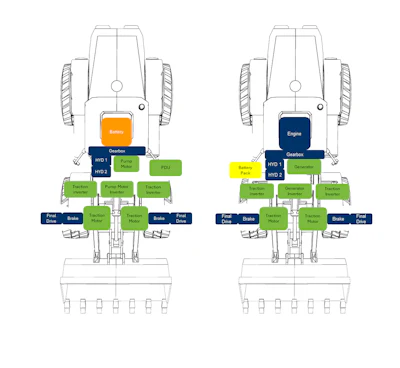
A hybrid lets you size the energy source or ICE for average power and the battery for peak power--two different jobs that a full-BEV is forced to combine. In addition, with hybrids, you’re able to reduce the size of the batteries. Based on the peak power and duty cycle you could potentially swap out a 250 kWh with a smaller 15 kWh battery pack. Customers don’t want to be hauling larger batteries around, because that space could be more efficiently used for what they are being paid to haul. With this reduction, you effectively address the cost, weight and volume issues for a highly efficient solution. Image 2. Example of a Fully Electric vs. Hybrid Electric Platform System ArchitectureParker
How should I look at efficiency?
There is lots of talk about efficiency in the market today, but not everyone seems to agree on exactly what efficiency means. At a basic level, efficiency is based on how much of the energy that goes into the system is converted into work. But there are also other ways to look at efficiency, such as the ability to do the same job with a battery that requires less space. A smaller ePTO would leave more space on the vehicle for batteries and ancillary equipment. Smaller typically also means lighter in weight, which helps with range and, ultimately, capacity and uptime which addresses major concerns around range anxiety.
There are a lot of efficiencies realized when you are able to reduce power while idling or when there is a very low load active. Yet, you need to be able to run the motor at both very high speeds and high torques, when necessary. Even at high power demands, when you add an ECO mode, you can add a mechanism that artificially derates the motor temporarily and limits the torque. When you do that, the motor will automatically slow down because, with less torque, it cannot maintain its speed and will slowly creep down to the most optimal efficiency points.
Controls also play a role in efficiency. With the right controls, you won’t create more flow or pressure than needed, and you won’t have idling losses. That’s why decoupling from the engine with an ePump helps a lot.
What do today’s customers want?
Customers rarely buy efficiency. They buy power density, payload, uptime, recharge convenience, and total cost of ownership. Efficiency is simply the means; those outcomes are the ends.
Manufacturers are already working on demand-based control strategies such that, when there is no demand on the hydraulic system, the electric motor isn’t just spinning and pumping fluid back to the tank. You can simply drop the speed down to zero essentially and not have an additional load. This compares favorably with traditional hydraulic systems that waste energy when flow is generated continuously and then simply returned to the tank when there’s no demand.
Another benefit of the newer demand-based control strategies is that they can reduce noise during light or no-demand operation, which is especially important to customers in certain applications, e.g. indoor, residential, and night work.
What are the considerations when choosing an efficient engine?
An important consideration when creating a hybrid is the engine. The goal is to reduce the size of that, as well, and to run it at what’s known as its sweet spot. With this approach, the battery can serve as a type of backup to handle the sudden spikes of power needed for work functions. This is also known as the intermittent duty cycle where the work function has peaks and periods when there is very little demand on the load side.
When your load requirements are low, the goal is to convert the electric motor into a generator that charges the small battery pack. In this way you can effectively run your engine in different modes—the boost mode, the eco mode, or the electric mode where there is a clutch installed.
Once the engine size has been reduced, you can downsize the entire hydraulic system downstream which creates a multiplier effect in terms of system efficiency. This is especially true for smaller off-highway equipment. Hybridization strategies for on-highway vehicles and larger equipment can be very different.
The greatest benefits of the hybrid architecture are realized when you’re able to get the diesel engine below the 56-kilowatt threshold by having the electric motor boost the peak loads. At this point, less stringent EPA and EU emissions regulations apply, which reduce complexity and costs.
Given the large number of variables and potential design complexities, it is always best to work closely with your engine supplier when developing a hybridization strategy.
What are the best ways to recover braking energy through regeneration and how do these options influence system design?
It is best to utilize regenerative braking before applying the mechanical friction brakes to recover energy from the battery and reduce brake wear. This can be done with one-pedal driving where the vehicle decelerates upon throttle release or by having a brake pedal with multiple zones. Image 3. Most kinetic energy is lost as heat during mechanical braking. Regenerative braking systems, using an inverter for bidirectional power flow, capture and store this energy, enhancing vehicle range and reducing brake wear.Parker
For vehicles with limited top speed, mechanical brakes may not be needed. Instead, the electric drive system could work in combination with the parking brakes to bring the vehicle to a stop and keep it stopped. With this approach, you’re relying on the regenerative braking system to perform that task.
A concern with this approach occurs when there is a fully charged vehicle on top of a hill. The first thing the driver does in the morning is to start driving down the hill. At this point there is a lot of potential energy that needs to go somewhere, but the battery can’t absorb it adequately because it is already fully charged.
There are several solutions for addressing this problem. You could turn on a resistor to simply dissipate the energy into heat. Or, you could push the hydraulic fluid over a relief valve. If you already have this kind of system, you can use it for dual purposes of absorbing the energy and turning it into heat.
On a battery-electric commercial vehicle, the energy can be used to support propulsion or directed to auxiliary and work functions. Here is where the power takeoff (PTO) becomes valuable. With an electric PTO (ePTO), the motor and motor controller are integrated, but it is still primarily a speed-based control. Going forward, the ePTO strategy is to optimize the efficiency of the hydraulic system.
What are some better steering options with hybrids?
With hydraulic power steering, the fluid circulates even when you’re driving straight and not actively steering. With hybrids, there are at least three better options for steering.  Image 4. Off-Highway Steering Evolution: From conventional to steer-by-wireParker
The first option is an electro-hydraulic power steering (EHPS) system that’s created by decoupling the pump from the engine. This option includes an AE pump that you drive, so you only need to create the flow that you need. This is unlike an ICE engine that creates the flow for a worst-case scenario, like at idle speed. And then, anytime the vehicle speeds up, the extra flow generated is simply dumped through a priority valve or something creating heat.
The second solution is a steer-by-wire system. In this case, you eliminate the steering control unit along with any other hydraulics that are in the cab of the vehicle and replace them with something like a tactile feedback input device. An advantage of a steer-by-wire solution is that it’s much easier to route the electrical wires through some sort of mast than other options require.
One problem, however, is that you are going to have redundant sensors for the safety-critical functions but, downstream it’s doing the hydraulic steering the same way. That doesn’t change.
The third and final solution uses electromechanical actuators (EMAs). With these, you are able to eliminate all hydraulics and replace them with some type of tactile feedback device. Downstream you would have an electromechanical actuator that responds based on the customer feedback.
How do I get started?
Start with your goals. Why are you electrifying your equipment? Is it to reduce emissions or noise or something else? Is total cost of ownership an overriding factor?
Then consider voltage selection and component sizing that’s appropriate for the duty cycle required by your machine. What type of work do you need to do? Where is all the energy going and what is the real work versus the wastage?
Common voltage ranges in the Industrial Mobile and Mobile Equipment industries are 48-120V, with 400-800V being more common in Zero Emissions On-Highway Vehicles. Of particular note are the machines that run on 60 volts and below because they offer a lot of regulatory and practical benefits. For example, with a lower voltage threshold, there is less worry about the touch safety of the electronics.
A challenge is that there are misconceptions in the market that a higher voltage directly equals more power. The reality is that power is voltage times current. That means you can achieve the same amount of power at a lower voltage by having more current.
However, there is a cost tradeoff to consider since you’ll spend more on copper wiring with this approach and you’ll have thicker cables running. But you’ll need fewer safeguards which can save money. Typically, when the motor peak currents exceed 500 ARMS, a higher battery voltage is appropriate. A consideration when weighing the options is your charging current, as well as the associated duration. Often this will be a deciding factor.
What are some of the latest and greatest innovations?
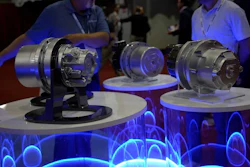
Integrated motors and controllers on ePumps and ePTOs allow for some exciting control methods that can yield higher efficiency gains than simple speed-based controls. A newer concept is virtual load sensing which allows back EMF to be sensed directly from the motor, providing high-speed load-based feedback. With this innovation, we could eventually have more model-predictive control instead of typical reactive PID control. Image 5. High voltage ePTO potential customizationsParker
Another area of focus as we look toward the next generation of machines is a gear reduction to drive the pump. The challenge is that pumps tend to work best at slower speeds than the optimal speeds of electric motors. By using a gear reduction, we can get both components to work in their respective sweet spots, and this would allow us to offer a variety of ratios to customers so they can achieve system efficiency across not only a wide range of applications, but also a wide range of pumps.