*Content sponsored by Regal Rexnord.
In many working environments today, complexity comes with the job. And with heavy equipment — especially in off-highway equipment — machines are expected to do more, last longer, and operate in these demanding conditions often times far from service centers. Under these realities, uncertainty can become the most expensive variable. Whether it manifests as unexpected downtime, premature component failure, or misaligned system adoptions, the cost is measured in lost productivity and downtime.
For OEMs and end users, success hinges on something more foundational in the approach: confidence in your parts. Confidence that each component will perform as intended no matter the circumstances. And increasingly, confidence that your components can adapt to the technology of the future. Achieving that level of assurance requires more than individual parts — it needs reliable, validated components supported by a solutions provider you can trust.
Reliability by Design: The Role of the Weakest Link
At the center of this conversation is the slightly unintuitive understanding that sometimes the most important component in a system is one that is designed to fail. Couplings, for example, are often engineered as the sacrificial link within a drivetrain. Their purpose isn’t only to deliver torque, but to protect the more costly assemblies — like engines, gearboxes, hydraulic systems — from damaging loads or misalignments. When a coupling fails under extreme conditions, it has fulfilled its role. The alternative leads to damage cascading further down the system and is far more disruptive to productivity.
This understanding is especially critical when considering where these components live. In many applications, couplings may not be easily accessible. Replacing them can require significant disassembly, extended downtime, and labor that may not be readily available in some circumstances. It’s in these circumstances that reliability is essential.
From Performance to Predictability
Predictability can best be achieved through a deep understanding of how components behave under real-world conditions. Advanced engineering methods, like torsional vibration analysis and simulation-based modeling, allow engineers to go beyond assuming and base calculations on certainty. These approaches help understand the dynamic forces that your components experience through things like misalignment, fluctuating torque, and system resonance.
For OEMs, this level of insight is crucial. When it comes to validating new designs, the cost is often substantial, so ruling out as many unknowns as possible reduces the likelihood of costly redesigns, unplanned downtime, and failures when it comes time to operation.
This understanding extends to the most critical applications as well. In systems that are responsible for braking or load control in large equipment for example, reliability is synonymous with safety so eliminating these risks directly impacts safety on-site.
Electrification and Hybridization: Preparing for a Gradual Shift
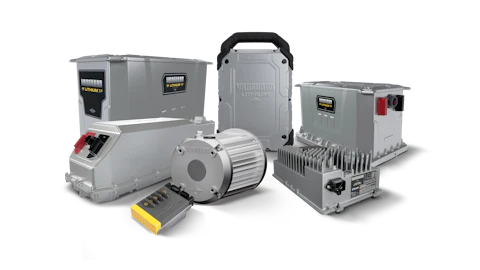
While the industry continues moving forward, a different kind of preparation shows its value. Electrification and hybridization though widely discussed and experimented with, present practical challenges in these kinds of heavy operations. Infrastructure limitations, energy demands, and the realities of remote jobsites complicate the adoption of these technologies, particularly for large-scale machinery. As a result, the transition is unfolding unevenly, with greater traction in smaller equipment segments and regions with stricter emissions regulations.
Despite these challenges, the long-term direction remains clear. As these systems evolve, components must adapt to new configurations, integrate with alternative power sources, and operate under changing conditions. The key to preparing for these advancements isn’t to anticipate every outcome, but to ensure that your current designs are built on a strong foundation of known performance. Components with well-defined behavior and validated operation envelopes offer OEMs a level of flexibility that makes them better prepared for the future ahead.
In this sense, the best preparation for electrification adoption is less about immediate transformation and overhauling of systems, and more about readiness. Selecting components that can bridge the gap between today’s systems and the future’s innovations.
The Advantage of a Broad, Integrated Solutions Portfolio
With all of these advancements — both mechanically and electrically — machines inevitably become more complex, and the limitations of a complex and fragmented supply base become apparent. Managing multiple suppliers across different component categories can introduce inefficiencies, misalignment, and missed opportunities for optimization. In contrast, a solutions provider with a broad, integrated portfolio offers a more cohesive approach.
Understanding and supporting multiple elements of the powertrain — couplings, bearings, clutches, and brakes — creates a foundation for system-level approaches in design. Components are designed with an awareness of how they interact with the larger system and each other. This alignment can improve performance, simplify integration efforts, and reduce the friction associated with managing a list of suppliers.
Building on What Is Known to Enable What Comes Next
The path forward for heavy equipment is not defined by a single trend, but instead, a collection of evolving technologies and efficiencies across a broad spectrum. Electrification will continue to advance, autonomy will expand, and system complexity will understandably continue to increase. Through it all, the principles that define successful operations remain largely unchanged.
Reliable, thoroughly validated components provide a strong enough foundation. Engineering insights transform performance into predictability. And solutions providers with both breadth and depth offer the continuity and expertise needed to navigate the changes ahead.
With this understanding, preparing for the future is not simply chasing and adopting every emerging idea that hits the market. It is about building on what is already understood — leveraging proven designs, trusted relationships, and broad engineering expertise — to create a system that is in itself resilient, adaptable, and ready for whatever comes next.