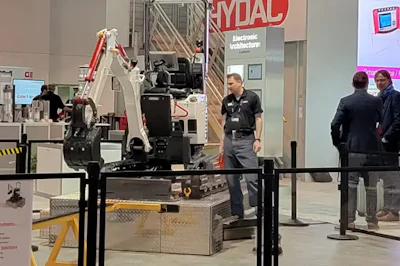
During CONEXPO 2026, HYDAC announced a shift in hydraulic system design aimed at improving the performance and reliability of compact hydraulic systems. The company introduced Fluid Architecture Engineering, a design philosophy intended to address the requirements of modern machinery by optimizing fluid health, deaeration and space utilization.
According to the company, traditional hydraulic design has historically relied on oversized components and rule-of-thumb calculations. Fluid Architecture Engineering moves away from this component-centric approach, focusing instead on how fluid is stored, conditioned, filtered and managed within a holistic system strategy.
A System-Level Approach to Design
The new discipline encourages original equipment manufacturers (OEMs) to plan fluid architecture in tandem with electrical, software and fuel systems during the initial design phase. This approach is specifically tailored for compact and electrified platforms where space constraints and efficiency are critical factors.
“In many compact and electrified platforms, the constraint isn’t the hydraulics, it’s the stability of the fluid architecture,” said Chris Kolbe, vice president of sales and marketing at HYDAC. “We pioneered Fluid Architecture Engineering to give OEMs a framework for designing compact, electrified, and automated machines that deliver both efficiency on paper and reliable performance in the field.”
HYDAC noted that the framework formalizes technical expertise in filtration, cooling, sensors and mechatronics to solve challenges associated with modern machine design.
Supporting Electrification and Automation
As the industry moves toward electrified and automated platforms, HYDAC is positioning itself as a design partner. The company utilizes data-backed simulations and system architecture expertise to help OEMs address hydraulic reliability concerns before designs are finalized.
Kolbe noted that challenges often attributed to software or controls can sometimes originate within the fluid environment. By involving fluid engineering early in the process, HYDAC aims to ensure the fluid environment is engineered for power density and maintainability.
CONEXPO Demonstrations and Audits
HYDAC showcased several elements of the Fluid Architecture Engineering approach at CONEXPO 2026, including:
- “Air is the Enemy” Simulator — A demonstration of how fluid aeration impacts system efficiency and reliability.
- SUSTAINMICRON Element Lab — An exhibit focused on how cleaner fluid and reduced electrostatic discharge contribute to component longevity.
- Invisible Threat Detector — A showcase of condition monitoring tools designed to detect fluid threats early.
To encourage the adoption of this discipline, HYDAC offered a complimentary fluid architecture audit for design engineers in the mobile and construction equipment sectors during the event.