As electrification reshapes the off-highway market, optimizing hydraulic systems has become a critical focal point for OEMs seeking to balance performance, cost and battery life.
The push for greater efficiency in off-highway equipment is intensifying, driven by rising operational costs, stringent emissions standards and the industry-wide shift toward electrification. While efficiency has always been a key design consideration, the move to battery-electric powertrains significantly amplifies the impact of hydraulic system performance. This new reality is compelling original equipment manufacturers to adopt a more systematic and data-driven approach to hydraulic design, moving beyond simple component selection to a holistic view of the entire machine architecture.
The core challenge and opportunity lie in the relationship between upfront investment and total cost of ownership (TCO). While advanced electro-hydraulic systems may increase initial machine costs, the long-term savings in fuel or battery life can deliver a substantial return on investment, particularly in the electric vehicle segment.
In his session at iVT Expo USA 2026, Olaf Pippel, product manager for compact hydraulics - HYDAC, covered the topic of smarter hydraulics, highlighting how they power efficient, intelligent off-highway machine performance.
The Amplified Impact of Hydraulics in Electrification
Pippel notes that improving hydraulic efficiency delivers benefits for both conventional and electric powertrains, but the gains are disproportionately higher for battery-powered machines. A 20% improvement in hydraulic system efficiency can yield a 15% improvement in the overall efficiency of an electric machine, compared to just a 6% gain for a conventional diesel-powered equivalent. This disparity is because the hydraulic system accounts for a larger portion of the energy consumption in an already more efficient electric powertrain.
These gains translate into significant financial incentives. For a conventional machine, a 20% hydraulic efficiency boost might result in annual operating cost savings of around $2,700. For an electrified machine, however, the same improvement could extend battery life from six to eight hours and deliver cost savings of approximately $13,500 per machine. This could come from lower operating costs or a reduction in the required battery size, which is often one of the most expensive components. According to Pippel, this trade-off between higher initial investment and lower TCO is central to the business case for advanced hydraulic systems in modern off-highway equipment.
A Systematic Approach to Optimization
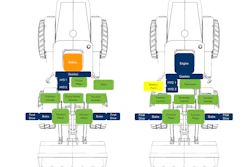
To capitalize on these potential gains, says Pippel, OEMs are moving toward a multi-level optimization strategy that begins with a detailed analysis of a machine's energy demands. This process often involves outfitting existing machines with sensors to map energy use or, for new designs, employing multiphysics simulations and digital twins. The goal is to identify which functions contribute most to energy consumption and which are used most frequently, allowing engineers to prioritize their efforts for maximum impact.
This data-driven analysis informs a tiered approach to implementation:
Level 1: Component-Level "Quick Wins." The most straightforward improvements involve swapping standard components for higher-efficiency alternatives. This can include changing pipe diameters, reducing hose lengths or selecting different valve sizes to lower pressure drop. For example, replacing a standard valve with a functionally identical but more efficient model can cut pressure loss at that single point nearly in half.
Level 2: Subsystem Integration. The next level involves optimizing integrated subsystems like manifolds. By designing a casting with flow-optimized channels and incorporating smart valves, engineers can achieve significant gains. In one application, this approach reduced pressure drop by 250 psi, a decrease of about 70%.
Level 3: Architectural Redesign. The most impactful changes involve rethinking the fundamental system architecture to recover or conserve energy. One such strategy is using an accumulator to capture potential energy. When lowering a heavy load like a boom, the energy is stored in the accumulator and then reused to help lift the boom, potentially improving energy efficiency by almost 30%. Similarly, implementing "zero power gravity lowering" technology can reduce power consumption by 20% compared to conventional load-holding valves.
Advanced Controls and Strategic Trade-Offs
Beyond hardware, advanced control strategies offer another avenue for significant efficiency improvements. Traditional load-sensing systems can be replaced with electronic load-sensing counterparts. By using a pressure sensor and a control algorithm to manipulate the pressure signal sent to the pump, these systems provide precise control over the pump's output. This method can reduce wasted power by more than 50%.
A case study on a lift and lowering truck illustrates the effectiveness of this targeted approach. By identifying steering and lifting as the highest-demand functions, engineers implemented a series of solutions that achieved nearly 70% energy savings on steering and over 25% on lifting, resulting in total machine energy savings of more than 50%.
While the pursuit of maximum efficiency is tempting, OEMs must balance technical perfection with market realities. The most efficient machine on the market may also be the slowest to market, creating a risk of losing market share. The optimal strategy involves a systematic, step-by-step approach that aligns efficiency goals with TCO targets and business timelines, ensuring the final product is not only high-performing but also commercially viable.