Choosing the right valve for off-road applications requires evaluating multiple factors beyond durability, including size, temperature, media compatibility, pressure, and end connections using the STAMPED criteria. Specialty valves with custom configurations, lockable handles, metric ports, and advanced sealing technologies are often necessary to meet the demanding requirements of harsh environments and complex hydraulic systems.
- Off-road equipment demands exceptionally robust valves due to severe vibration, extreme temperatures, and heavy contamination exposure
- The STAMPED criteria (Size, Temperature, Application, Media, Pressure, End connections, Delivery) guides proper valve selection and prevents costly mistakes
- Specialty valves address space constraints, complex configurations, low-pressure lines, and chemical compatibility needs that standard valves cannot handle
- Full bore valves maintain uninterrupted flow paths and prevent pressure drops, while straight-thread O-ring innovations eliminate sealant contamination risks
- Quality differentiators include 100% individual testing, PTFE seats, forged brass construction, and metric port options for superior performance and longevity
Equipment working in off-road environments is often subjected to severe vibration, extreme temperatures and heavy contamination. So the components chosen for this equipment, including the ball valves used to route flow and backflow, need to be exceptionally robust. But durability is only one of multiple considerations when choosing the right valve for an off-road application.
Today there are more options when it comes to choosing a ball valve for a specific off-highway application than ever before. One reason is that, as engineering departments have become more advanced with their designs and approaches, they are also using larger engines and manifolds.
Choosing the right type starts with identifying what the valve needs to accomplish in the hydraulic, engine cooling or compressed air system. It needs to fit the application, as well as the required functionality.
When evaluating technical specifications, it’s always best to use the industry-standard STAMPED criteria, which includes:
- Size (flow capacity)
- Temperature
- Application
- Media compatibility
- Pressure
- End connections
- Delivery (which ensures accessibility to replacement/spare valves)
After considering the STAMPED criteria, you may determine that a custom valve is necessary. Of all the criteria, it’s the size, temperature and ends that most often dictate if something special is needed.
When and Why You May Need a Specialty Valve
There are many reasons why you might require something out of the ordinary.
- More space is needed. You might need to fit a certain part into an existing assembly where space is limited. Mini and micro valves are ideal for these types of situations. Sometimes you might also need to consider the size of the handle to ensure there is room to fully rotate it.
- Existing configuration is too complex or costly. The stacking of existing products can get too complex or costly. If the ball valve needs to be serviced, it’s more efficient to have just one part. That’s why today there are more valves with nontraditional configurations that can replace multiple products.
- A multi-port solution is required. Some valves need multiple ports. One multi-port valve can provide the ideal solution because one product saves space.
- The situation requires low pressure. Most parts of a hydraulic system are required to run at high pressure. Return lines, however, are an example of a place where a low- pressure valve is needed.
- The handle on the valve is located where it can be accidentally kicked or moved. Valves with lockable handles represent a safer solution because they can’t accidentally be turned on or engaged. Prior to having this option, operators were often forced to use zip ties to keep a valve handle steady.
- The need to redirect excess flow volume. In hydraulic, pumping, and industrial process systems, a special three-way diverter valve is needed in “spillback” (recirculation or bypass) situations to maintain a constant minimum flow rate through critical equipment by redirecting flow. These types of valves are also ideal for use in highly serviceable areas.
- Containment of contaminants in the air. Drain cuffs are critical additions to air relief/release valves because they manage the unintended expulsion of liquids and other contaminants during the air venting process. The body of these specialized parts typically are made of 100% brass to provide the necessary durability.
- Concerns regarding chemical compatibility. Rising diesel costs mean there is greater demand for less expensive alternative fuels. Often, however, these fuels require specialized materials, or the valves need to be plated inside and out, to avoid chemical incompatibility, which can lead to degradation and premature system failures and leaks. Today there are compatible materials and additives for nearly any fuel.
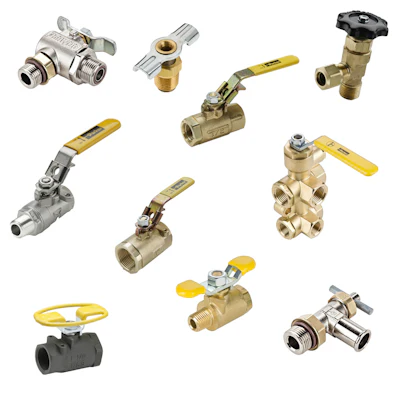
- Because a traditional handle just won’t suffice. Modern valves have more handle options because of changing design priorities, tighter spaces, safety codes and new materials. Today’s specifiers can choose from levers, short levers, T-handles, oval handles and locking handles, to name just a few of the many choices.
- Special venting requirements. When using compressed air or in applications involving compressible fluids, a specialized vented ball valve is needed. It features a small, calibrated relief port drilled into the outlet side of the ball, so that when the valve is closed, the hole allows expanding gases to safely vent out to the environment, creating a safe serviceable disconnection point.
- Keeping up with growing global metric standards. Valves that use a metric port offer several distinct engineering and operational advantages. Not only are they more widely used in other parts of the world besides the U.S., but they typically also rely on a superior O-ring sealing, they allow for smaller external envelopes and tight port spacing, have the ability to withstand demanding hydraulic and pneumatic pressures, and can be easily maintained and inspected.
If you encounter any of the above-mentioned situations, you will likely be reaching out to a supplier to help you identify newer, better and more custom-valve options.
Not all Valves Are the Same
Valves are typically considered a commodity product, but that doesn’t mean all valves are the same. Too often, the importance of having the right valve is minimized, it may be completely overlooked in the design process or simply not given the consideration it deserves.
Valve quality and robustness can vary greatly, putting your system at greater risk of leaks. That’s why some manufacturers individually test their valves 100% as an added quality control measure. The company also uses PTFE for its seats and valves to ensure smooth handle movements and forged brass, instead of machined brass, for product robustness. Yet another differentiating factor is whether or not a valve is classified as full bore (or full port). Full bore valves maintain an internal bore size that matches the exact diameter of the pipe to deliver an uninterrupted, straight flow path that improves flow and prevents pressure drops.
Most Noteworthy Innovations in Valves
The reality is that there hasn’t been a lot of innovation in valves because many of the old solutions still work. Two areas of innovation worth noting, however, include the development of straight-thread O-rings, which typically use an NPE tapered thread to create a more fool-proof solution.
Straight parallel threads only provide mechanical holding strength, while a separate elastomeric O-ring compressed against a machined chamfer does the actual sealing work. Since the threads do not deform to create a seal, it’s possible to assemble and disassemble straight thread fittings repeatedly without degrading the connection or port. In addition, no thread sealant is needed. This eliminates the risk of sealant fragments breaking off and contaminating fluid systems. Plus, the elastic O-ring absorbs minor vibrations and pressure spikes well, making them ideal for hydraulics.
The NPE tapered thread represents a self-sealing design. The conical, narrowing walls wedge together during assembly to build the seal directly into the thread interface. Tapered threads are typically also capable of handling very high static pressure ratings.
The second area of innovation includes the use of plating to improve durability and ensure chemical compatibility. Not all companies use plating in their valve offerings. Rather, they rely on stainless steel options which are considerably more expensive.
There have actually been more changes to handle designs over the years than to the valves themselves primarily to promote safety, ease of use, and space savings. Newer connections are also more common which means that today’s valves need to be able to adapt to them.
Conclusion
As various segments of the off-road sector experience tremendous growth, the demand for valves and innovation in valves also grows. The construction industry, largely driven by massive demand for AI data centers, clean energy infrastructure, new manufacturing plants and affordable housing shortages, is one such booming industry where the demand for ball valves is skyrocketing. In industries such as this, product robustness is especially important because of the rugged work environments and the fact that valves are typically installed on the bottom of the product where they are subject to additional vibration, abrasion, weight and debris.
Most people can easily understand the need for valves to be robust so they don’t leak, regardless of the demands placed on them. But the right valve is about so much more than just durability. Valves also need to be easy to turn, easy to install, easy to access for maintenance, and easily adapt to various spaces, configurations, temperatures and pressures.
Fortunately, original equipment manufacturers (OEMs) have already responded to this demand, which explains why there are more valve options on the market today than ever before. Choosing the right one, however, is a process that should not be taken for granted. By following a few simple guidelines and working with the right supplier who possesses the necessary technical knowledge and has the desired product depth and breadth with an array of configurations, choosing the right valve is relatively simple and fool-proof.