Industrial machinery is increasingly required to deliver lower emissions, reduced noise, improved energy efficiency, and lower operating costs while maintaining the durability and productivity expected from heavy-duty equipment. Construction, mining, material handling, port operations, and other industrial sectors typically involve high transient loads, long duty cycles, harsh operating environments, and limited tolerance for downtime. In these applications, full battery-electric operation is not always immediately feasible because of duty-cycle demands, charging infrastructure limitations, installation constraints, or the need for extended range and high availability. Hybrid-electric powertrains therefore offer an important intermediate and, in many cases, long-term solution.
Scania’s electrified power-system portfolio has been developed around modularity, system integration, and scalability. The company positions its electric power solutions as an extension of its experience in electrifying on-road vehicles, with components designed to simplify installation, maintenance, and integration across multiple applications. Scania states that its electric components are modular and scalable, controlled by a common management system, and supported by standard mechanical interfaces for integration with external components.
Scania’s hybrid solution is based on a parallel-hybrid architecture in which the internal combustion engine and e-machine can operate together or independently. In hybrid mode, the e-machine can provide torque support during launch, acceleration, transient load changes, or peak-power demand. This allows the combustion engine to be selected closer to the average duty-cycle requirement rather than the peak-power requirement, creating opportunities for engine downsizing without sacrificing performance. In applications where maximum power is not continuously required, the e-machine can reduce the operating load and operating time of the combustion engine, contributing to lower fuel consumption and reduced emissions.
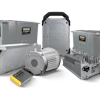
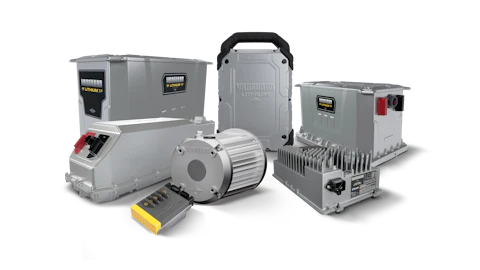
The architecture includes the e-machine, inverter, batteries, internal combustion engine, cooling system, charging interfaces, mechanical connection interfaces, VCB cables, and auxiliary equipment. These components are coordinated by a master power unit, which manages the interaction between the combustion and electric power sources. Scania introduced this complete parallel-hybrid solution for construction and mining applications last year, emphasizing the value of delivering the full system from a single supplier rather than requiring the OEM to integrate separate subsystems from multiple vendors.
A major advantage of the parallel-hybrid configuration is operational flexibility. The machine can operate in electric mode in noise- or emission-sensitive zones, in hybrid mode when additional power or range is required, and in combustion-dominant mode when long-duration operation is necessary. This flexibility is particularly relevant for urban construction machinery, industrial vehicles operating indoors or near residential areas, port equipment, mining support vehicles, and heavy-duty transport platforms.
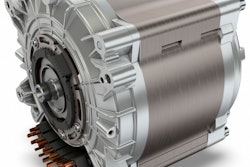
The e-machine is the central component in Scania’s hybrid system. Unlike a simple add-on electric motor, it is part of an integrated driveline concept that can support hybrid propulsion, fully electric operation, and generator operation depending on the application configuration and control strategy. One of the key design features is the integrated clutch within the e-machine. This clutch enables the electric machine to be mechanically coupled to or decoupled from the internal combustion engine, allowing the system to operate either as a combined hybrid powertrain or as a standalone electric drive.
This clutch arrangement is important for the transition toward full electrification. An OEM can initially use the system as a hybrid solution, preserving range, uptime, and familiar engine-based operation while adding electric torque and electric-mode capability. As battery capacity, charging infrastructure, and operational requirements evolve, the same modular approach can support movement toward full battery-electric operation. Scania’s published material notes that its hybrid electric systems allow the engine and e-machine to operate together or as standalone power sources, and that the adapted speed range of the electric machine can avoid the need for a reduction gear, reducing energy loss and simplifying equipment design.
The integrated clutch also improves functional flexibility. In electric operation, the combustion engine can be disconnected, reducing noise and eliminating local tailpipe emissions for limited operating periods. In hybrid operation, the electric machine can support the engine during high-load events. In generator operation, the system can convert mechanical energy into electrical energy for charging or auxiliary power, depending on the installation.
The electric machine is listed with 230 kW continuous power at 2,100 rpm and 295 kW peak power at 1,400 rpm. It delivers 1,400 Nm continuous torque and 2,000 Nm peak torque from 0 to 1,400 rpm, with a speed range of 0 to 2,900 rpm. The system voltage is 650 V DC, the cooling method is oil cooling, and the listed weight is 280 kg including the inverter. These values correspond to approximately 0.82 kW/kg continuous power density and approximately 1.05 kW/kg peak power density when calculated from the published mass including inverter.
Thermal management is a critical determinant of electric-machine performance in industrial duty cycles. Many machines in construction and mining operate under repetitive high-load conditions rather than short, intermittent load events. In such applications, continuous power and continuous torque are often more important than peak values alone. Scania’s use of oil cooling is therefore significant because oil cooling can support heat transfer from active electrical and mechanical components in a compact package, allowing the e-machine to maintain high output over sustained duty cycles.
The relatively small gap between continuous and peak ratings supports this industrial-use case. For example, the global specification of 230 kW continuous and 295 kW peak power indicates that the continuous rating is approximately 78 percent of peak power. In the industrial hybrid datasheet configuration, 230 kW continuous power compared with 280 kW peak power indicates a continuous rating of approximately 82 percent of peak power. This characteristic is beneficial in equipment where productivity depends on repeatable high-load operation rather than occasional boost performance.
High continuous torque also enables more effective engine downsizing. Instead of selecting a larger combustion engine to satisfy short-duration peak loads, the system can use the electric machine to supply torque during launch, acceleration, lifting, gradeability events, or other transient operating conditions. This can allow the internal combustion engine to operate closer to efficient regions of its fuel map during steady-state operation while retaining the power reserve needed for demanding work cycles.
The mechanical interface is a critical factor in the adoption of hybrid powertrains by equipment manufacturers. A technically strong hybrid system can still be difficult to commercialize if it requires extensive redesign of the engine bay, driveline, gearbox interface, or mounting structure. Scania addresses this issue through standard mechanical interfaces and compact integration.
The industrial hybrid e-machine datasheet specifies an SAE 1 flange interface to the combustion engine and an SAE 1 flange interface to the driveline. This allows the e-machine to be integrated between the engine and gearbox or driveline without the need for a separate mechanical interface or an additional reduction gearbox in suitable applications. Scania’s published material also states that the adapted speed range of the electric machine can avoid the need for a reduction gear, which minimizes energy losses and simplifies equipment installation.
For OEMs, this interface strategy reduces integration risk. It allows electrification to be introduced into existing machine architectures with less disruption to driveline layout, mounting strategy, and service procedures. It also supports modular product planning, where different machinery platforms can share common electric components while varying battery capacity, engine selection, or control calibration according to the duty cycle.
The practical value of Scania’s hybrid system lies in the combination of performance, flexibility, and integration. In electric mode, the system can reduce noise and local emissions, improving suitability for urban construction sites, indoor logistics areas, ports, and environmentally sensitive zones. Lower noise levels also improve the work environment for operators and nearby personnel. In hybrid mode, the electric machine provides additional torque and power when required, supporting productivity without relying solely on a larger combustion engine.
The system also supports improved energy efficiency. Electric torque from zero speed gives strong launch response and reduces the need for the combustion engine to operate inefficiently during low-speed transient events. In applications with frequent starts, stops, and load changes, this can improve overall fuel efficiency. Scania’s industrial hybrid material also emphasizes reduced fuel consumption, lower operational costs, reduced noise, and reduced emissions as key benefits of the hybrid configuration.
From a life cycle perspective, a single-supplier system can simplify ownership. Because Scania supplies the electric machine, inverter, batteries, engine, control system, and associated interfaces as an integrated package, customers and OEMs benefit from a clearer service responsibility structure. This is especially important for industrial operators, where downtime is costly and maintenance organizations must manage both mechanical and high-voltage electrical systems.
The transition to full electrification will not occur at the same pace across all industrial applications. Some machines have predictable duty cycles, fixed routes, and access to charging infrastructure, making them well suited to battery-electric operation. Other machines require long range, remote operation, high duty-cycle flexibility, or rapid refueling, making hybridization more practical in the near term.
Scania’s modular hybrid system provides a bridge between these operating realities. It allows operators to gain the benefits of electrification — electric torque, reduced noise, reduced emissions, improved transient response, and potential engine downsizing — while retaining the range and operational familiarity of combustion-based systems. At the same time, the integrated clutch and modular electric architecture allow the same platform logic to be adapted toward fully electric operation as infrastructure and application requirements mature. Scania has positioned this approach as part of a broader portfolio of hybrid, fully electric, and fuel-efficient combustion power solutions for sectors such as construction and mining.
Scania’s modular parallel-hybrid system represents a technically robust approach to industrial electrification. Its key engineering strengths are the integration of the e-machine, inverter, battery system, internal combustion engine, cooling system, mechanical interfaces, and control architecture into a coordinated in-house solution. The oil-cooled e-machine provides high continuous torque and high power density in a compact package, while the integrated clutch enables hybrid, electric, and generator-capable operation depending on application requirements. The SAE 1 interface further improves installation practicality by supporting integration with conventional engine and driveline layouts.
For industrial customers, the system offers a pragmatic route to lower fuel consumption, reduced noise, reduced local emissions, improved transient performance, and potential engine downsizing without compromising uptime or operational flexibility. For OEMs, the modular single-supplier architecture reduces integration complexity and supports scalable electrification across multiple platforms. As charging infrastructure, battery technology, and regulatory requirements continue to evolve, hybrid systems of this type are likely to play an important role in bridging current heavy-duty machinery requirements with the longer-term transition to fully electric industrial powertrains.