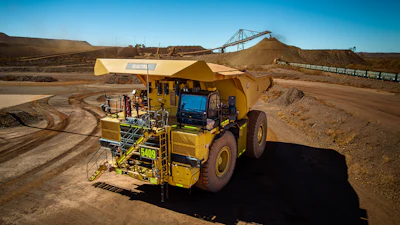
BHP, Rio Tinto and Caterpillar have initiated a trial of two Cat 793 XE Early Learner battery-electric haul trucks at BHP’s Jimblebar iron ore mine in Western Australia’s Pilbara region. The project is part of an industry-first collaboration aimed at addressing the challenge of reducing greenhouse gas emissions in large-scale mining operations.
The trucks arrived at the Jimblebar site late last year following safety validation and controlled testing at Caterpillar’s Tucson Proving Ground in the United States. The Jimblebar mine currently hosts two of seven Caterpillar Early Learner battery-electric haul trucks being tested globally.
Operational Testing and Infrastructure Evaluation
The trial has already completed more than 100 hours of operation and over 200 test laps. This early phase is designed to generate critical data to assess technical readiness, infrastructure requirements and commercial feasibility. The testing includes the evaluation of high-powered static and dynamic charging solutions.
The scale and operational intensity of the Pilbara make it a primary testing ground for the technology. Insights gained from the trial help validate assumptions regarding safety, technology and maintenance of the battery-electric fleet.
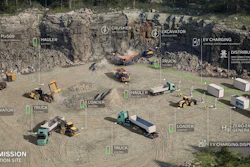
The next phase of the trial will evaluate dynamic charging through an energy transfer system designed to charge the trucks while they are in motion. This technology is viewed as a potential key to maintaining operational efficiency while transitioning to electric fleets.
Industry Collaboration for Decarbonization
The trial reflects a broader industry effort to reach net-zero goals. BHP is currently working toward a target of at least a 30% reduction in operational greenhouse gas emissions by FY2030 from FY2020 levels.
"Investing in battery-electric haul truck fleet technology and operations in the Pilbara is key to our decarbonization," said Geraldine Slattery, BHP president Australia. "This trial is helping to advance the technology we need and improve our understanding of how to scale across our operations, from charging infrastructure and energy management through to how it integrates into safe and productive operations."
Matthew Holcz, Rio Tinto Iron Ore chief executive, emphasized the importance of real-world data in demanding conditions. "The Pilbara's scale and intensity are unique, and that's exactly what makes it the right place to test this technology to understand what’s needed to support broader deployment," Holcz said.
Thad Litkenhus, Caterpillar Resource Industries vice president of product management, stated that working in the Pilbara allows the company to validate trucks and charging infrastructure in the exact conditions customers face. "The progress we’re seeing is helping accelerate the development of solutions that our customers can implement with confidence," Litkenhus said.
Western Australia Premier Roger Cook and other government officials recently joined representatives from the three companies and dealer WesTrac to observe the trucks in operation, noting the region's role in the global energy transition.