According to its recent Off-Highway Vehicles report, Interact Analysis market analysts are forecasting an upswing in the production of construction vehicles, reporting projected moderate growth in 2026, followed by strong growth in 2027, particularly in North America and Europe, along with the Middle East and Africa (EMEA) regions.
The report goes on to present data supporting the recovery of the global off-highway vehicle market after its 2024–2025 cyclical downturn. It is expected to enter a period of steady growth, reaching 7.8 million units by 2030 at a 5.3% average annual growth rate.
Growth will be led primarily by the agriculture and material handling sectors, while construction equipment production is expected to rebound strongly in 2027 in North America and EMEA, with projected growth of 13% and 9%, respectively. In contrast, China and the broader Asia-Pacific (APAC) region are expected to see declining construction vehicle production, driven by policy uncertainty, weaker private investment, and slowing manufacturing activity.
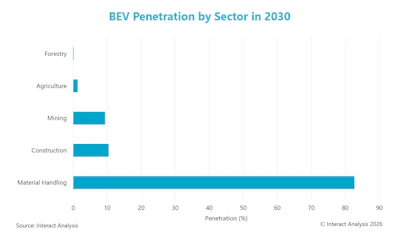
Electrification is also gaining momentum, with battery-electric vehicles (BEVs) projected to increase from 33% of off-highway units in 2025 to 44% by 2035, although adoption remains heavily concentrated in material handling, where BEVs are particularly well suited to indoor, low-duty applications.
Small machines dominate the overall market, with 63% of units below 35 kW, while larger 36-100 kW and 100+ kW equipment represents a more significant future opportunity for electrification.
Outside of material handling, however, most agriculture, road-building, dozer, and forestry applications are expected to remain primarily diesel-powered through the forecast period.